The United States Navy faces a critical challenge as it seeks to modernize its air capabilities in response to growing threats, particularly from China. The USS Gerald R. Ford, the Navy’s newest and largest aircraft carrier, recently arrived in the US Southern Command area of operations. This deployment, ordered by former President Donald Trump, brings with it Carrier Air Wing 8, equipped with advanced fighter planes and electronic attack and surveillance aircraft. While these assets enhance strike options and tracking capabilities, the Navy’s aging fleet of aircraft poses a significant risk to future operations.
Despite the successful deployment of aircraft carriers in various operations, including Operation Rough Rider, the persistent issue of outdated planes threatens naval aviation’s effectiveness. The Navy has emphasized the urgent need for the new F/A-XX fighter program, which is designed to enhance the Navy’s aerial capabilities in the Pacific. In June, Adm. James Kilby, the acting Chief of Naval Operations, stated, “We need F/A-XX in the United States Navy.” The Navy’s objective is clear: to ensure the capability to engage effectively in extended-range combat scenarios.
The Pentagon’s indecision regarding the future of the Navy’s air power has raised concerns. There have been various excuses for delaying the F/A-XX program, including doubts about the survivability of aircraft carriers against advanced Chinese missiles and the suggestion that drones might replace manned fighters. Additionally, there was a controversial claim that the aerospace industrial base could not support the simultaneous development of both the Air Force’s F-47 and the new Navy stealth aircraft. Meanwhile, China’s advancements in carrier technology and stealth aircraft continue to progress, posing a growing threat to US naval power.
The Need for Enhanced Range and Capabilities
To effectively counter China, the Navy requires a strike aircraft equipped with the necessary range, survivability, and munitions for long-range engagements. The strategic imperative is to expand the operational range of carrier-based strike fighters, maximizing their lethality and tactical flexibility. Historical precedents, such as the development of the Grumman F6F Hellcat during World War II and the F-14 Tomcat during the Cold War, illustrate the importance of range and capability improvements.
Over a decade ago, the Navy recognized the need to prepare for China’s military advancements and initiated the F/A-XX program with a comprehensive plan. This strategy includes the development of longer-range missiles, a stealthy aerial refueling drone, and a new strike fighter designed for extended range and enhanced payload. The Long-Range Anti-Ship Missile (LRASM), which was showcased during Trump’s visit to the USS George Washington in Japan, exemplifies this new capability. The F/A-18EF has also integrated the SM-6 missile, which boasts a range of approximately 300 miles.
The MQ-25 Stingray, a stealthy aerial refueling drone set to join the fleet in 2026, will play a crucial role in enhancing operational range. This drone will not only provide air refueling capabilities but also enable strike fighters to extend their mission radius significantly. By offloading fuel at distances of up to 500 nautical miles from the carrier, the MQ-25 will allow carrier-based aircraft to operate more effectively and freely.
Urgent Action Required for F/A-XX Development
The F/A-XX fighter is envisioned as a larger, stealthier aircraft capable of carrying more payload than current aircraft in the Navy’s air wing. With an estimated unrefueled combat radius exceeding 750 nautical miles, the F/A-XX could significantly enhance the Navy’s strike capabilities. When combined with advanced missiles like the SM-6/AIM-174B and on-station refueling from MQ-25 drones, the operational range could extend to 1,000 to 1,500 miles from the carrier.
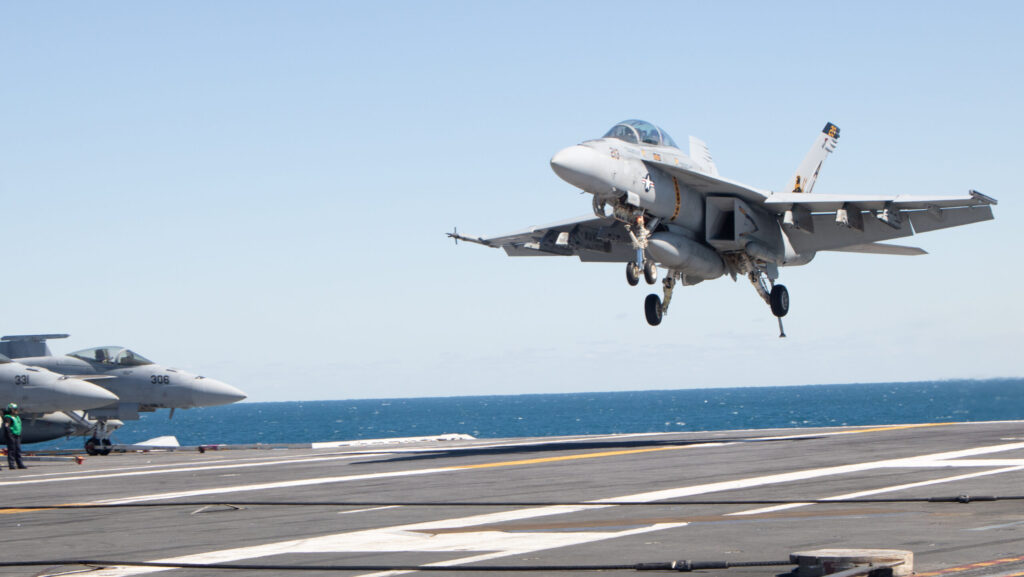
The urgency of developing the F/A-XX cannot be overstated. Production of the F/A-18EF is set to conclude in 2027, making the F/A-XX its designated successor. Both Boeing and Northrop Grumman have developed mature prototypes for the F/A-XX, with suppliers and production lines ready to commence. A timely decision to advance to the next phase of engineering and manufacturing design could initiate a countdown towards low-rate initial production by 2028 or 2029.
As the geopolitical landscape continues to shift, the Navy must prioritize the F/A-XX program to maintain its competitive edge. Delays in this critical development could undermine the effectiveness of naval aviation in the face of advanced threats. The Pentagon’s leadership must heed the Navy’s call to action and expedite the F/A-XX program now to ensure the United States remains capable of safeguarding its interests in the Pacific and beyond.