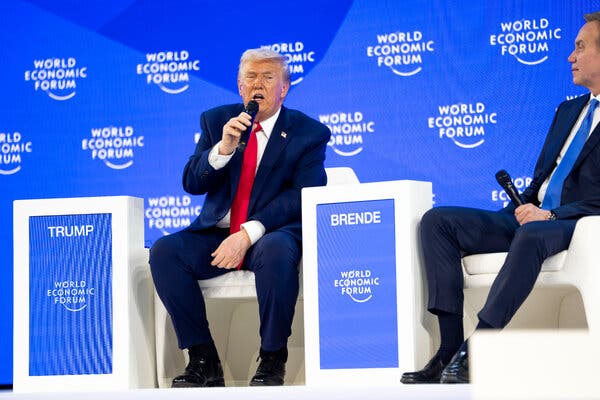
President Donald Trump has reignited fears of a trans-Atlantic trade war by threatening European nations over demands related to Greenland. During a four-day period, he indicated that punitive tariffs could be imposed if European countries did not comply with his requests. This volatility caused stock markets to react sharply, prompting emergency meetings among European leaders and a halt to trade negotiations that had taken months to finalize.
Following the initial threats, President Trump adjusted his stance, announcing that an agreement had been reached regarding Greenland and the Arctic. While details about this “framework” remain scarce, Trump described it as a potential “great deal” for the United States. Consequently, he stated that planned tariffs on eight European countries, set to take effect on February 1, 2024, would no longer be necessary, leading to a surge in stock market activity.
Impact on Global Trade Relations
Despite averting immediate trade conflict, Trump’s actions have created a climate of uncertainty that is destabilizing global trade. As tensions rise, European leaders and businesses are increasingly questioning the reliability of cooperating with the U.S. administration. This uncertainty threatens to undermine the very trading systems that the Trump administration aims to establish.
Moreover, Trump’s approach has inadvertently encouraged nations to strengthen ties with one another, particularly as they look to counterbalance the influence of the United States and, notably, China. As the second year of Trump’s second term unfolds, he has had significant opportunities to reshape the global trading landscape. Yet, his continued ultimatums and threats to existing trade agreements suggest a preference for disruption over stability.
Global businesses had anticipated a year of predictability following the establishment of several trade agreements. While tariffs were expected to remain elevated, the hope was that a clearer framework would emerge. Instead, President Trump’s latest moves indicate a willingness to inject new chaos into international commerce, leaving many stakeholders in a state of apprehension.
The ongoing fluctuations in trade policy not only affect market dynamics but also influence diplomatic relations. As countries reassess their alliances and trade dependencies, the long-term implications of Trump’s tactics could reshape global economic interactions for years to come.