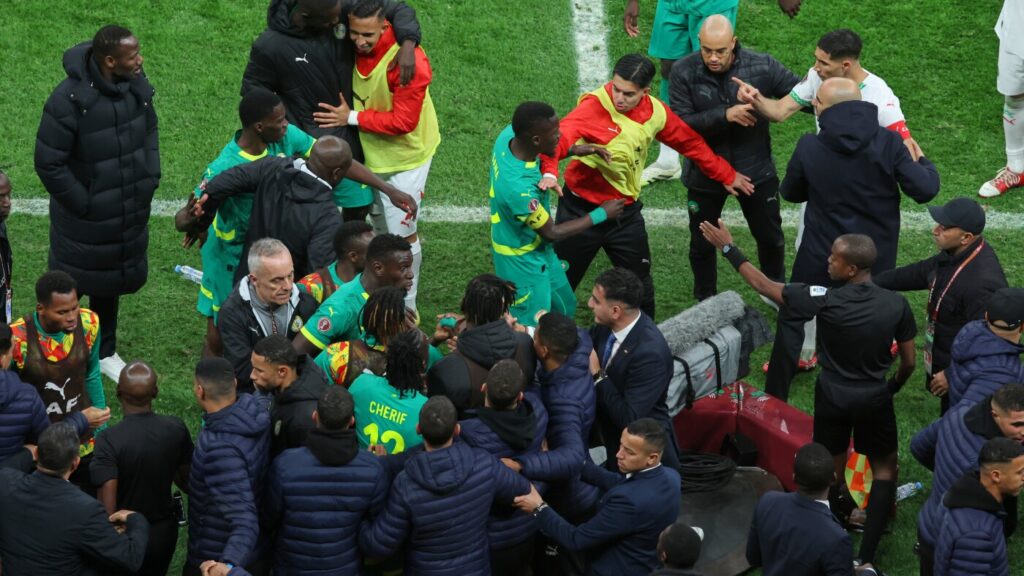
Players from both sides clash after a controversial penalty was awarded to Morocco late on during the Africa Cup of Nations final soccer match between Senegal and Morocco in Rabat, Morocco, Sunday, Jan. 18, 2026. (AP Photo/Youssef Loulidi)
The Confederation of African Football (CAF) has imposed fines exceeding $1 million and issued bans to players and officials from Senegal and Morocco following a tumultuous African Cup final on January 18, 2024. The match, which ended in a 1-0 victory for Senegal after extra time, was marred by protests, crowd disturbances, and altercations among journalists.
The CAF announced fines of $615,000 for the Senegalese football federation and $315,000 for the Moroccan football federation due to unsporting conduct by players, coaching staff, and fans. The sanctions specifically pertain to incidents that occurred during the final held in Rabat, including a protest led by Senegal’s coach, Pape Thiaw, against a controversial penalty awarded to Morocco late in the match.
In response to his actions, Thiaw received a ban from five African matches and was fined $100,000. Following a delay in the game due to the protest, the penalty was ultimately missed by Morocco, allowing Senegal to secure the championship title.
Incidents During the Final
The final also witnessed a chaotic atmosphere, with fans attempting to storm the field and players from both teams engaging in confrontations on the sidelines. A noteworthy incident involved Moroccan ball boys trying to distract Senegal’s goalkeeper, Edouard Mendy, by attempting to seize a towel he was using. This behavior contributed to a $200,000 fine levied against the Moroccan football federation.
Morocco’s coach, Walid Regragui, criticized the match’s conduct, stating it presented a “shameful” image of African soccer. The fallout from the final extended beyond the pitch, straining diplomatic relations between Senegal and Morocco. Political officials from both nations have since emphasized the importance of maintaining amicable ties.
In terms of player sanctions, Senegal’s Iliman Ndiaye and Ismaila Sarr received bans for two matches each, while Morocco’s Achraf Hakimi was also banned for two matches, with one of those suspended. Ismael Saibari faced a more severe penalty, receiving a three-match ban and a $100,000 fine for unsporting conduct.
Reactions and Implications
The CAF rejected Morocco’s appeal to overturn the match result in light of Senegal’s protest. This decision has further fueled tensions, as both nations grapple with the implications of the match. Rights groups in Morocco have condemned instances of hate speech targeting sub-Saharan African individuals in the country, reflecting broader societal issues that have arisen from the incident.
In a statement following the match, Senegal’s Prime Minister, Ousmane Sonko, remarked that reactions to the game should be viewed as emotional responses rather than signs of cultural or political divisions. He emphasized the need for calm and mutual understanding between the two nations.
As both Senegal and Morocco prepare for the upcoming 2026 FIFA World Cup, which they have both qualified for, the repercussions of this chaotic final will undoubtedly linger in the minds of players and fans alike. The events have not only highlighted the challenges facing African soccer but also the need for improved conduct both on and off the field.