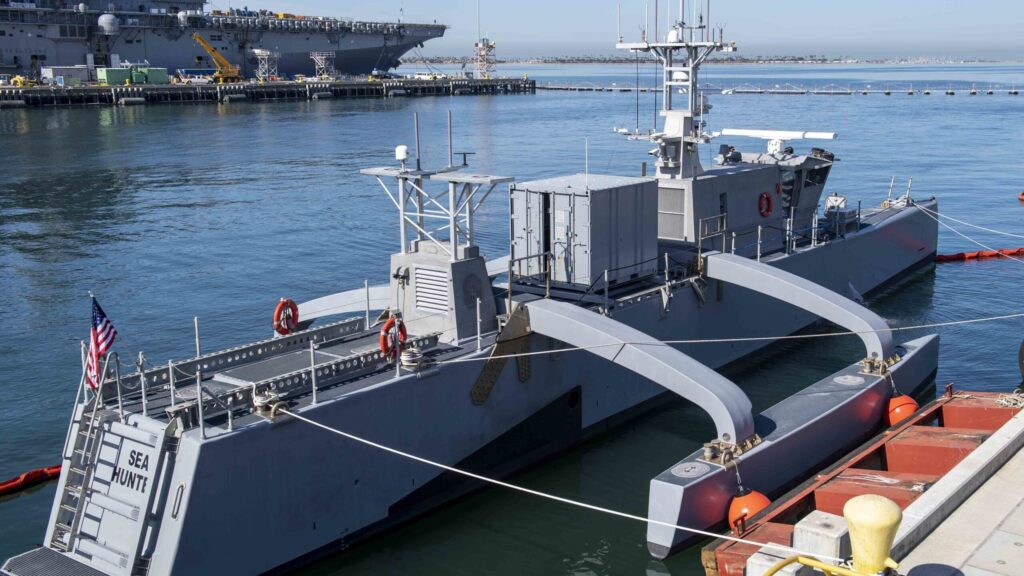
The United States Navy has confirmed that it will deploy two medium-sized drone boats, the Sea Hunter and Seahawk, in 2026. This announcement was made by Capt. Garrett Miller during the Surface Navy Association conference held in Washington. According to Miller, these vessels will transition from being experimental prototypes to operational assets integrated within the fleet.
At the conference, Miller, who serves as the commodore of Surface Development Group One, emphasized that the drone boats, officially classified as medium displacement uncrewed surface vessels (MDUSVs), will be assigned to surface forces. He stated, “They will actually be under fleet control, assigned to surface forces to be able to actually go out and do great things.” The Navy plans to integrate one of the drones with a carrier strike group, although specifics regarding the exact vessel or group remain undisclosed. Reports suggest that the Seahawk will be the drone involved in this deployment.
Expansion of Uncrewed Technology
In addition to the deployment of the MDUSVs, Miller announced that the Navy plans to establish three “early command” unmanned surface vehicle divisions next week. These divisions are intended to evolve alongside the Navy’s increasing investment in unmanned technologies. By 2027, the Navy aims to have a total of 11 MDUSVs in its operational inventory, with projections indicating this number will exceed 30 by 2030.
Both the Sea Hunter and Seahawk are manufactured by Leidos and have previously been utilized as pathfinder prototypes in various Navy exercises. The Sea Hunter was developed under a Defense Advanced Research Projects Agency (DARPA) program and initially served as an unmanned sub tracker and sensing platform. Building on the insights gained from the Sea Hunter, the Navy awarded a contract for the Seahawk in 2017, with delivery completed in 2021.
The introduction of these uncrewed vessels is expected to enhance a variety of maritime missions, including counter-mine operations, kinetic strikes, and intelligence, surveillance, and reconnaissance activities. Nevertheless, Navy officials acknowledge that further work is needed to establish comprehensive concepts of operation for these technologies.
Future of Unmanned Systems
The Navy’s strategic vision includes a significant role for drone technology in its future operations. In a separate discussion at the conference, Rear Adm. Christopher Alexander noted that unmanned systems are anticipated to become a dominant force within the Navy. He projected that by 2045, unmanned systems could constitute approximately 45 percent of the surface force. Alexander, who serves as special assistant to the commander for naval surface forces at the US Pacific Fleet, remarked, “The future is now. Unmanned systems, autonomous systems. AI, it’s not the future. It’s happening right now.”
As the Navy advances its unmanned capabilities, officials stress that these drone vessels will complement manned ships rather than replace them. The ongoing development reflects a broader initiative by the Pentagon to leverage drone technology across military operations, marking a pivotal shift in naval strategy and capabilities.