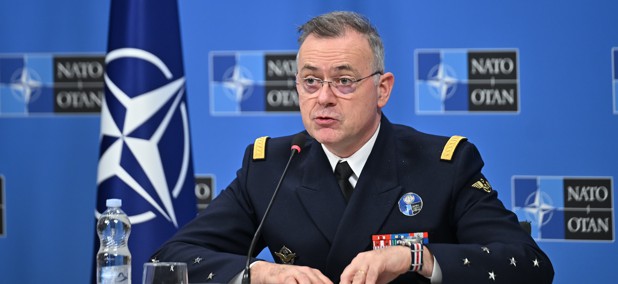
In a critical address in Washington on Tuesday, Adm. Pierre Vandier, head of NATO’s Allied Transformation Command, emphasized the urgent need for the alliance to enhance its technological capabilities to deter potential Russian aggression. He noted that NATO’s military presence alone cannot guarantee security; it requires a demonstrable ability to deploy new technologies as rapidly as Russia.
Adm. Vandier highlighted lessons learned from the ongoing conflict in Ukraine, where Ukrainian forces have demonstrated the importance of not only acquiring new technology but also continually adapting it in real-time combat situations. He pointed out that Russia is equally aware of these dynamics, having improved its capabilities in areas such as space-based imagery, mission command, and drone warfare.
“If Russia perceives NATO as lagging behind, there is a significant risk of a miscalculation similar to what occurred in 2022 with their invasion of Ukraine,” Vandier stated. He warned that a slow transformation over the next decade could undermine NATO’s deterrent effectiveness.
The war in Ukraine has also exposed inherent challenges within NATO regarding the procurement and development of weapons. According to Vandier, “The obsolescence is nearly immediate,” meaning that even the most advanced systems can become outdated quickly. “You need engineers and technicians close to the front lines to deliver rapid solutions.”
Recognizing NATO’s historical reputation for bureaucratic sluggishness, Vandier asserted that this perception is changing. He cited the REPMUS 24 experiment in Portugal, where NATO members successfully deployed over 70 autonomous systems in under three weeks. The previous iteration of this exercise last spring involved more than 276 unmanned systems, showcasing a shift towards more agile operations.
In the coming months, NATO plans to conduct additional experiments in Romania and Latvia to evaluate new counter-drone technologies and their integration into a comprehensive defense network, often referred to as a “layered defense.” These initiatives aim to bolster NATO’s readiness against emerging threats.
Artificial intelligence also plays a crucial role in NATO’s modernization efforts. The alliance is launching a project named SINBAD, in collaboration with Planet Labs, to enhance early warning systems by analyzing satellite imagery for military activity changes. This project aims to improve situational awareness and responsiveness in the face of evolving threats.
Additionally, a recent initiative seeks to streamline advanced wargame planning processes, which currently demand extensive time and manpower. “Creating a large-scale scenario for a small exercise typically takes 18 months of work for 60 people,” Vandier explained. “We aspire to reduce this to less than two months with half the staff.”
As NATO continues to adapt and innovate, its leaders remain focused on ensuring that the alliance can respond effectively to any potential threats, particularly from Russia. The coming years will be crucial in determining whether NATO can maintain its deterrent posture in an increasingly complex security landscape.