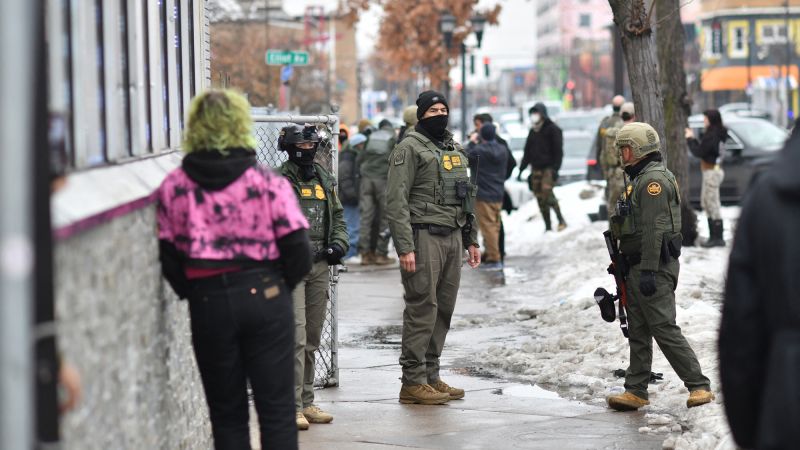
The presence of federal immigration agents in Minneapolis and St. Paul has led to severe economic repercussions for local businesses. Agents from the U.S. Immigration and Customs Enforcement (ICE) have been spotted around notable establishments, including El Burrito Mercado, a Mexican supermarket and restaurant. The heightened enforcement has created an atmosphere of fear among both customers and employees, resulting in a significant decline in sales and foot traffic.
Melissa Silvia-Diaz, the CEO of El Burrito Mercado, expressed her concerns in a phone interview, describing how the “unmarked vans and masked agents” have turned her business into a “hunting ground.” After staff members called in sick and shoppers opted to stay home, Silvia-Diaz found herself closing the store early. “They’re swirling around the block waiting for people,” she stated, highlighting the pervasive anxiety affecting her and her employees.
The spike in ICE activity, which has reportedly led to more than 2,000 arrests according to the Department of Homeland Security, has prompted many legal and undocumented immigrants to avoid public spaces. Business owners in the region compare the current atmosphere to the economic downturn experienced during the COVID-19 pandemic. Many establishments have reported drops in sales ranging from 50% to 80%, leading to shorter operating hours and, in some cases, temporary closures.
Community Impact and Legal Action
The situation escalated following the tragic death of Renee Good, a U.S. citizen, who was killed by an ICE agent last week. This incident prompted widespread concern, leading to the cancellation of several events, including a planned arts festival and a performance by comedian John Mulaney. In response to the economic fallout, the Twin Cities and the state of Minnesota have filed a lawsuit against the Trump administration, seeking to halt the operations.
Silvia-Diaz and other business owners are grappling with how to sustain their operations under such conditions. “This is not sustainable,” she noted, questioning how businesses can survive amid such uncertainty. Since the increased ICE presence, El Burrito Mercado has seen a drastic shift in its customer demographics, with a noticeable absence of its predominantly Latino clientele.
Miguel Lopez, owner of Homi, a Mexican restaurant in St. Paul, has also felt the impact. He recently closed the dining area and shifted to takeout-only service. “I don’t feel safe either in my house or my business,” Lopez remarked, prioritizing the safety of his employees and himself.
Target’s Role and Economic Concerns
The crackdown has extended its reach to major corporations, with Target, headquartered in Minneapolis, becoming a focal point for ICE activities. Reports indicate that immigration officials have arrested employees at various Target locations. Local leaders are urging the company to take steps to protect its workers and customers.
Target’s chief human resources officer addressed employees through an internal communication, referring to the ICE operations as “events in our hometown.” The company has not publicly commented on the situation but has assured staff that they are closely monitoring developments.
The broader implications of the ICE operations are concerning for Minnesota’s economy. As noted by the Minnesota Chamber of Commerce, the state is experiencing a slowdown in population growth, with an increasing reliance on immigrant labor to fill job vacancies. The report highlights that nearly 94% of the state’s net population growth from 2020 to 2024 was driven by immigration.
Mike Logan, CEO of the Minneapolis Regional Chamber of Commerce, emphasized the importance of immigration to the state’s economy. “My larger fear is this has a much broader impact in terms of attraction and retention of talent,” he stated. The ongoing operations leave many local businesses and communities in a precarious position, uncertain of what the future holds.
Minnesota’s diverse economy, supported by significant employers such as 3M, General Mills, and the Mayo Clinic, risks facing long-term challenges if the current enforcement actions persist. The situation calls for immediate attention to ensure the stability and growth of local businesses and the communities they serve.