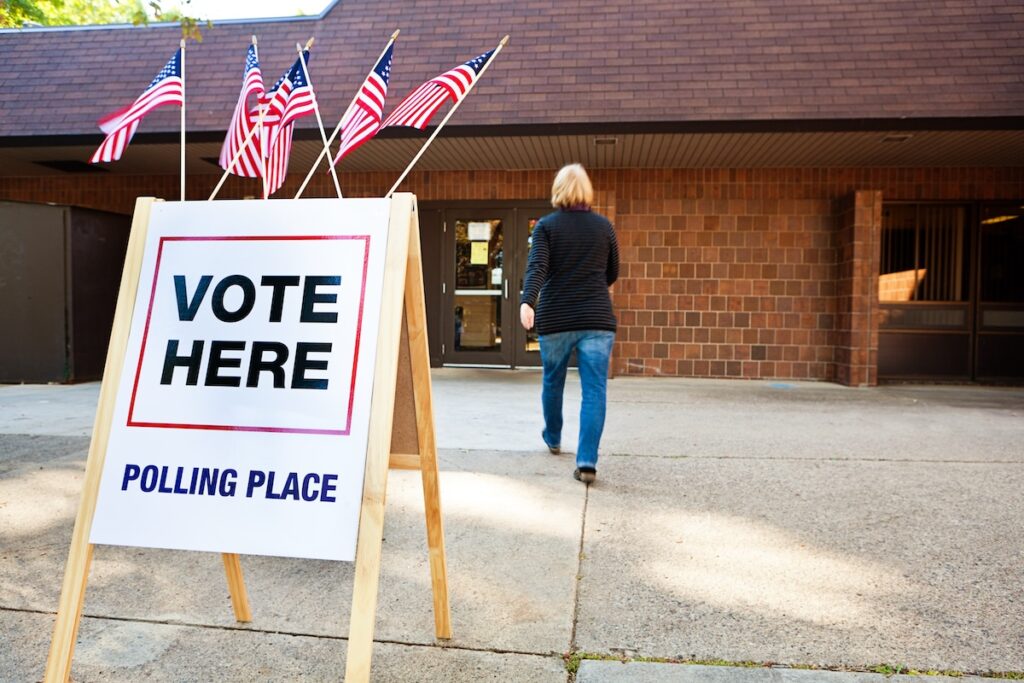
Unidentifiable woman voter entering a voting polling place for USA government election. Rear view shows her walking briskly in blurred motion by a sign decorated with American flags. For concepts of one person one vote, voter registration, voting booths, presidential and legistlative national and local decisions, democracy, and civic responsibility.
A federal judge has dealt another significant blow to the Trump administration’s attempts to reshape election rules across the United States. On March 15, 2024, U.S. District Judge John Chun ruled against key provisions of an executive order issued by former President Donald Trump, reinforcing that the Constitution grants states and Congress—not the president—the authority to govern elections. This decision marks the third successful challenge to Trump’s election-related agenda in the courts.
The executive order, issued in March 2023, sought to impose stricter requirements on voter registration, including the need for documented proof of citizenship. Additionally, it aimed to restrict the use of machine-readable codes for ballot counting and to prohibit the counting of absentee ballots that were postmarked by Election Day but arrived late. With this latest ruling, the administration is expected to appeal, although legal experts suggest it faces a challenging path.
David Becker, an elections lawyer and head of the Center for Election Innovation & Research, stated, “The more courts look at this executive order, the more they come to the conclusion that the president vastly exceeded his constitutional authority.” This sentiment underscores the mounting legal difficulties Trump’s administration has encountered in its election reform efforts.
Judge’s Ruling and Its Implications
In his ruling, Judge Chun sided with the states of Oregon and Washington, which argued that the executive order’s provisions overstepped presidential powers. He specifically blocked requirements for proof of citizenship on federal voter registration forms and the directive to stop counting ballots arriving after Election Day. Chun emphasized that his decision aimed to “restore the proper balance of power” envisioned by the Founding Fathers between the Executive Branch, states, and Congress.
While the ruling directly affects Oregon and Washington, both states that primarily utilize mail-in voting, it sets a precedent that could influence similar legal challenges nationwide. The judge also invalidated provisions linking federal election funding to compliance with the controversial proof-of-citizenship requirements.
The U.S. Election Assistance Commission (EAC) is now prohibited from changing the federal voter registration form to include these additional requirements. Chun’s decision reflects a broader judicial trend that counters the administration’s push for more restrictive voting measures.
Limited Success for Trump’s Election Agenda
Despite the setbacks in court, the Trump administration has continued to advocate for changes to federal election laws. However, many of these efforts have stalled in Congress, where bipartisan support for new legislation has proven elusive. The administration has also called on state lawmakers to advance its policy goals, yet, for the most part, states have resisted significant changes.
Legal expert Derek Clinger from the University of Wisconsin Law School noted that the executive order’s impact has been limited, particularly at the state level. He remarked, “There are just two available constitutional paths for people in the federal government to change election policy in the states: an act of Congress or persuading a state Legislature to change state election law.”
While some Republican-majority states have enacted laws to eliminate mail-voting grace periods, the overall effect of Trump’s executive order remains minimal. Clinger pointed out that the order has served more as a directive for federal agencies, prompting the U.S. Department of Justice to prioritize election law violations. The department has filed multiple lawsuits against states that have refused to provide unredacted voter data.
Election law professor Justin Levitt criticized Trump’s approach, arguing that it aims to “project power that he doesn’t have.” He likened the administration’s strategy to a comedic scenario, where the steps to achieve a goal are unclear, leaving the public skeptical of the underlying motives.
As the legal battles continue and the administration plans future actions, the implications of these court rulings will likely shape the conversation around election integrity and access in the United States. The outcome of the appeals and potential future executive actions will be closely monitored by lawmakers, legal experts, and voters alike.