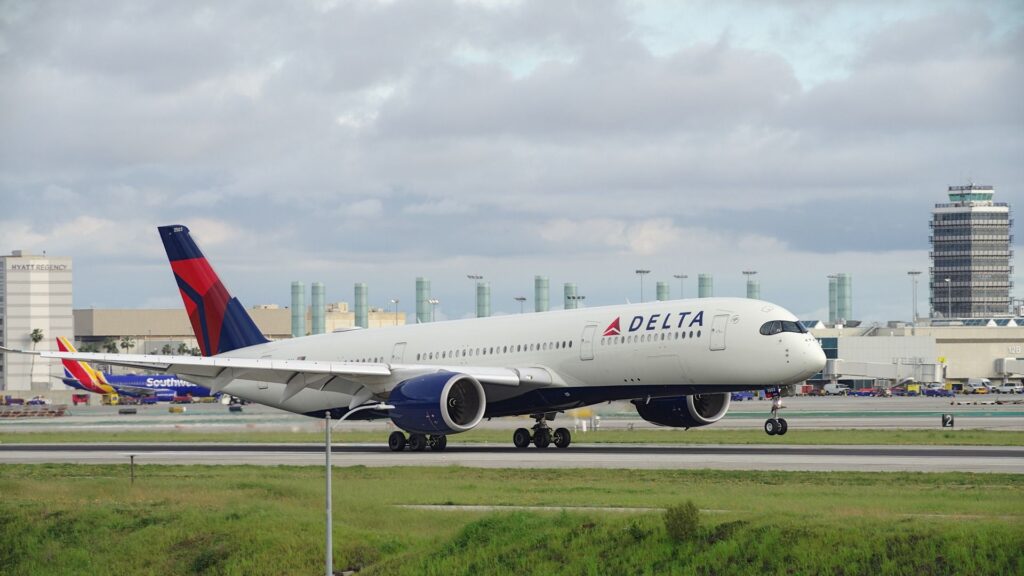
Passengers aboard a Delta Air Lines flight experienced an unexpected detour to Japan after their Airbus A350-900 encountered hydraulic issues. The incident occurred on November 28, 2023, during Delta Flight 388, which was en route from Shanghai to Detroit. Approximately 140 nautical miles (259 km) from Tokyo, the crew decided to declare an emergency and diverted to Tokyo Haneda Airport (HND), where the runway was temporarily closed upon arrival.
The aircraft landed safely at 16:28 local time. Emergency teams were on standby and met the flight as it touched down in the Japanese capital. The precautionary landing was prompted by concerns over the hydraulic system, a critical component for aircraft control. The flight was then towed to the gate, and the runway resumed operations after about 30 minutes.
Delta Air Lines operates a daily non-stop service between Shanghai Pudong International Airport (PVG) and Detroit Metropolitan Wayne County Airport (DTW). Typically, this journey lasts around 13 hours, departing from Shanghai at 17:30 and arriving in Detroit at 18:05 on the same day. On the day of the incident, Delta Flight 388 had pushed back from the gate at 17:46, heading northeast towards the United States.
As the aircraft flew over Japan, the crew detected a hydraulic issue that necessitated the diversion to the nearest major airport. According to a spokesperson for Delta, “On November 28, the crew of Delta Flight 388 followed procedures to divert to Tokyo-Haneda after reporting a mechanical issue while en route from Shanghai to Detroit. The aircraft landed safely, and we apologize to our customers for the delay in their travel plans. Nothing is more important than the safety of our customers and crew.”
Following the emergency landing, the aircraft remained in Japan overnight. Data from Flightradar24 indicates that the nearly seven-year-old A350-900, registered as N512DN, stayed on the apron before being repositioned to Seattle-Tacoma International Airport the following day. The aircraft departed from Haneda as DL9888 on November 29 at 23:14, arriving in Seattle at 14:26 on the same day. A corresponding service was then added to Detroit, arriving at 23:02.
The Airbus A350-900 involved in this incident, bearing registration N512DN, was first delivered to Delta in January 2019. It features a three-class configuration with 32 Business, 48 Premium Economy, and 226 Economy class seats. The aircraft is powered by two Rolls-Royce Trent XWB-84 engines and is one of 38 A350-900s in Delta’s fleet.
Hydraulic issues on the Airbus A350 are uncommon but can lead to serious safety concerns, including uncommanded flight surface movements. Such risks prompt airlines to take immediate action to ensure passenger safety, as evidenced by the crew’s decision to divert to Japan for careful inspection.
Following the incident, the aircraft returned to regular service on November 30, operating a flight from Detroit to Seoul. It is currently scheduled to fly from Seoul to Atlanta on December 1, reflecting Delta’s commitment to maintaining operational integrity and passenger safety in all circumstances.