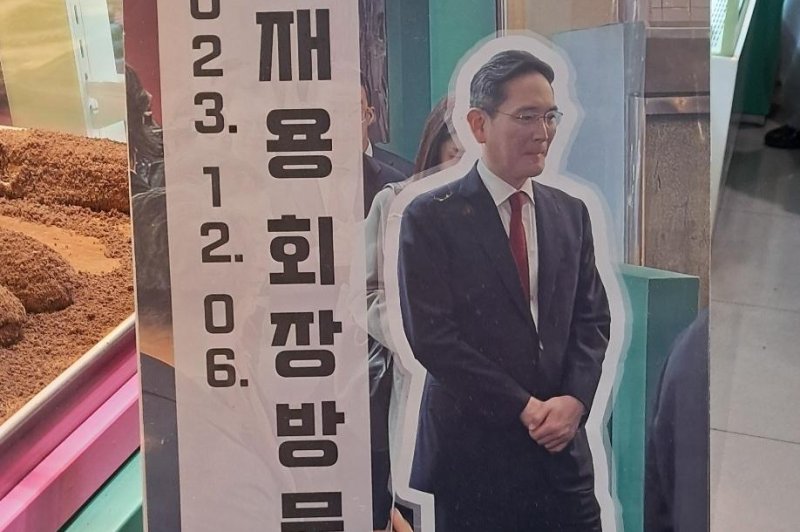
Samsung Electronics Chairman Lee Jae-yong has emerged as a significant business figure in South Korea, transforming perceptions of his leadership. His visit to a fusion cake shop in Busan in late 2023 has unexpectedly boosted the local business, turning it into a popular destination. The store now features a promotional sign celebrating his visit, with customers often ordering the same cakes he tried. Employee Shin Jae-yeon noted, “His visit continues to help our sales,” illustrating the impact of Lee’s stature on local commerce.
The enthusiasm surrounding Lee’s visit reflects a broader shift in public sentiment. Many now view him not merely as the heir to a conglomerate but as a capable and accomplished businessman. Choi Hyun-jin, a housewife from Seoul, expressed her admiration, saying, “I hope I can become wealthier by eating this cake,” while acknowledging the positive energy she believes is associated with the chairman.
Under Lee’s leadership, Samsung’s affiliates, including the world’s top memory chipmaker and leading contractor, have performed exceptionally well. Share prices for these subsidiaries have surged in the past year, enhancing Lee’s personal fortune significantly. He holds a 1.45% stake in Samsung Electronics and a 20.82% stake in Samsung C&T. According to the CXO Institute, Lee’s stock values have surpassed $20 billion, making him the first South Korean businessman to reach this milestone, surpassing the previous record of $15.22 billion set by his late father, Lee Kun-hee.
The ongoing demand for semiconductors, particularly in relation to the current AI boom, is expected to further increase Lee’s wealth. Oh Il-sun, chief of the CXO Institute, noted that government efforts to bolster the stock market have also played a role in this growth. “More people recognize him as the definitive leader of the country’s No. 1 conglomerate,” he stated.
Lee’s ascent has not been without challenges. Born in 1968, he studied history at Seoul National University before pursuing business administration at Keio University in Japan and Harvard University in the United States. His path to leadership began in 2014 when, following the sudden heart attack of his father, he became the de facto leader of Samsung Group. His tenure was marred by a political corruption scandal involving former President Park Geun-hye, resulting in two prison sentences. He resumed his corporate role in 2022 after receiving a presidential pardon.
Despite these hurdles, Samsung Electronics faced challenges in the high bandwidth memory (HBM) market, which is crucial for AI chips. Although the company had historically dominated the global memory sector, it lagged behind rival SK hynix in securing early HBM supply contracts. However, industry observers have noted that Samsung has been narrowing the gap by developing next-generation HBM technologies.
The evolving public perception of Chairman Lee is also influenced by personal factors. Economic commentator Kim Kyeong-joon highlighted the significance of Lee’s son, who renounced his U.S. citizenship and joined the South Korean Navy. “That decision helped a lot to strengthen public respect for Chairman Lee and the Samsung family,” Kim stated, contrasting the actions of many heirs to major Korean businesses who seek to avoid military service.
As Samsung continues to deliver strong profits and investors see solid returns, public sentiment towards Lee appears to be shifting positively. The combination of his business acumen, personal sacrifices, and the successful performance of Samsung’s subsidiaries positions him as a prominent figure in the South Korean business landscape, reflecting a new narrative of leadership in a historically influential conglomerate.