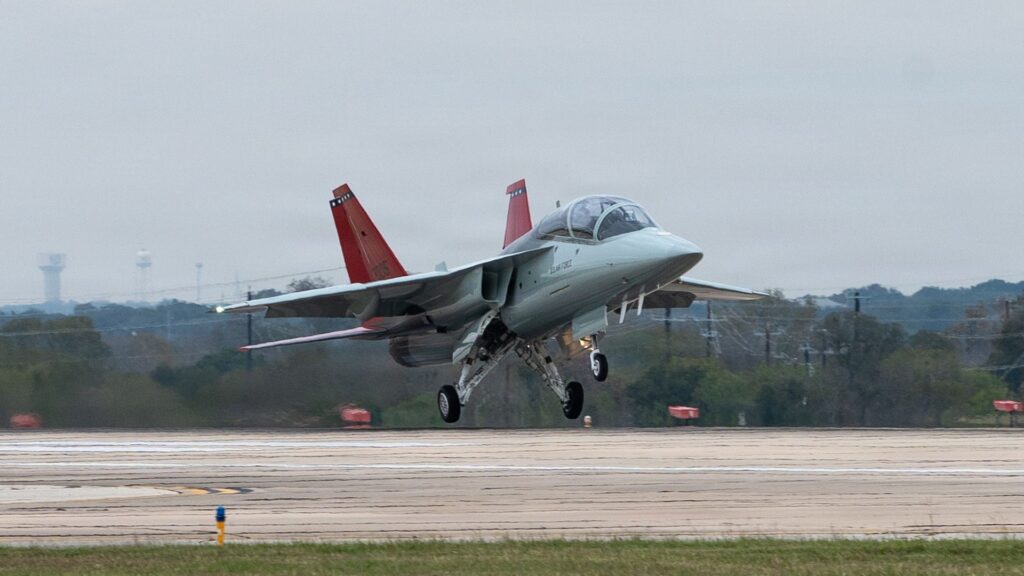
On December 5, 2025, the United States Air Force (USAF) marked a significant milestone with the delivery of its first T-7A Red Hawk jet. This advanced aircraft arrived at Joint Base San Antonio-Randolph, where it will be integrated into the 99th Flying Training Squadron of the 12th Flying Training Wing. The T-7A is set to play a vital role in the Air Force’s efforts to enhance its combat training systems.
The introduction of the T-7A Red Hawk signifies the beginning of an operational plan to boost the capabilities of the Advanced Pilot Training System. Designed to replace the aging T-38C Talon, the T-7A aims to prepare pilots for fifth- and sixth-generation aircraft more effectively. With its digital design and integration with simulators, the Red Hawk is expected to modernize the training of fighter and bomber aviators for years to come.
Launching a New Era in Pilot Training
The Air Education and Training Command (AETC) officially initiated its Red Hawk program with the jet’s touchdown on December 5, flown in by Boeing test pilot Steve Schmidt alongside leadership from the 99th FTS. A formal arrival ceremony for the aircraft is planned for a later date. USAF leaders view the T-7A as a critical step forward, representing the first tangible proof of momentum in the program, which is crucial for replacing the outdated T-38C, originally introduced in the early 1960s.
According to analysis from the USAF, the sustainment costs for the T-38C continue to rise, highlighting the need for a modern replacement. The T-7A will be integrated with ground-based training, maintenance trainers, and live virtual constructive scenarios to enhance student learning in information management and sensor-driven decision-making. The AETC aims for initial operational capability by August 2027, with plans to assign 14 jets to the 99th FTS.
The T-7A features open-architecture avionics, allowing instructors to customize training according to individual student performance. This flexibility is essential for developing the skills needed for modern aerial combat.
Building a Comprehensive Training Ecosystem
The T-7A Red Hawk is more than just a new aircraft; it represents a complete ecosystem for pilot training. Alongside high-fidelity simulators and comprehensive course materials, students can rehearse complex missions before conducting actual flights. This approach allows for a combination of live flights with virtual threats and constructive forces, which is essential for preparing pilots for the complexities of fifth-generation training.
Randolph’s 99th FTS is currently building a cadre of instructors and maintainers while the AETC revamps training syllabi, moving away from merely updating older aircraft systems with newer software. With fly-by-wire controls, the T-7A allows for adjustable handling limits, enabling instructors to tailor early sorties to individual student needs. This personalization may reduce the number of flights required to achieve proficiency.
Boeing’s digital design methodology is expected to facilitate quicker upgrades as training requirements evolve.
The successful delivery of the first T-7A Red Hawk is a pivotal moment for a program that has faced numerous technical and scheduling challenges. Reports have indicated issues such as high-angle attack instability and supply chain disruptions, which have delayed key milestones, including the commencement of low-rate production in 2025. The Air Force’s current planning indicates that initial operational capability for the first aircraft will be achieved by August 2027 at Randolph, with aspirations for a future fleet of hundreds of aircraft and numerous simulators to gradually replace the T-38 fleet.
The stakes surrounding the T-7A program are high, as modern fighter and bomber operations demand pilots with advanced skills suited for the information age. Each year of delay in operational deployment prolongs reliance on a trainer aircraft designed for an earlier era. If integration proceeds as planned, the T-7A Red Hawk has the potential to significantly enhance training throughput and overall readiness across USAF air bases.