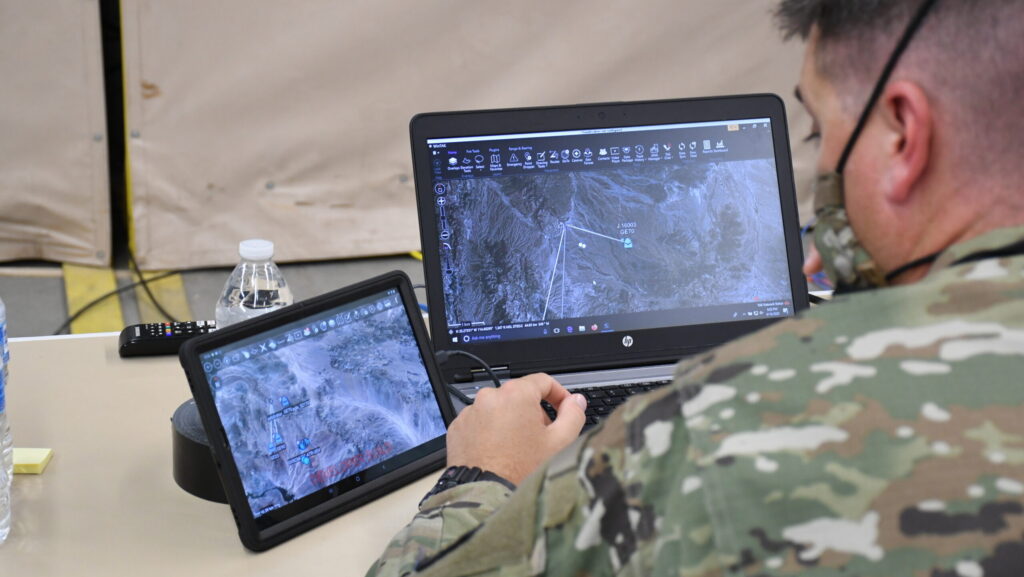
The United States Army is set to accelerate its Next Generation Command and Control (NGC2) initiative in 2026, focusing on a series of experiments aimed at expanding the application of new technologies. The Army plans to initiate smaller-scale experiments for one NGC2 prototype while also testing another prototype with an entire division. This approach reflects a commitment to developing a comprehensive framework that enables soldiers and commanders to effectively process, visualize, and share battlefield information, ultimately enhancing decision-making capabilities.
Strategic Developments and Testing Plans
The NGC2 initiative is characterized as a clean-slate approach, allowing the Army to build from the ground up. The objective is to create an integrated architecture that grants a tactical advantage in dynamic combat situations. For 2026, the Army has awarded contracts to both Anduril and Lockheed Martin, which will collaborate with various vendors to refine and scale their respective prototypes.
Part of this effort includes the Ivy Sting series, a set of events conducted by the Army’s 4th Infantry Division. These events, occurring approximately every six weeks, progressively introduce new capabilities. Following three successful Ivy Sting events, the division will conduct three additional tests in the coming year, culminating in a division-wide exercise known as Ivy Mass. This event will transition into the broader high-tech environment of Project Convergence, where the efficacy of the NGC2 architecture will be rigorously evaluated.
One significant aspect of the upcoming tests is the focus on contested environments. According to Maj. Gen. Patrick Ellis, Commander of the 4th Infantry Division, upcoming Ivy Sting events will incorporate “red teams” to simulate adversarial conditions. This will help assess how well the NGC2 architecture performs under electromagnetic stress and during soldier maneuvers in scenario-based exercises.
Parallel Efforts and Future Goals
At the same time, the 25th Infantry Division is engaged in a parallel initiative called Lightning Strike, led by Lockheed Martin. This effort will focus on developing an integrated data layer and is set to commence in early 2026.
The Army is dedicated to incorporating a diverse range of capabilities and vendors into the NGC2 ecosystem. Brig. Gen. Shane Taylor, the capability program executive for command, control, communications, and networks, indicated that the Army aims to make informed purchasing decisions regarding the NGC2 architecture before the culmination of Project Convergence. This proactive approach allows the Army to adopt effective technologies sooner rather than waiting for the final event.
Ultimately, the goal is to equip division commanders with a baseline set of capabilities that they can adapt based on their specific operational needs. Taylor emphasized the importance of learning from each division’s experiences, stating, “What do we learn out of PCC6, we will come out of PCC6 with a system of systems architecture of what that division wants to look like and how they want to fight.”
As the Army continues to refine its NGC2 efforts, it remains committed to integrating lessons learned from both the 4th and 25th Infantry Divisions to shape future capabilities. This will help ensure that each division’s unique requirements are met, thereby enhancing overall operational effectiveness in complex combat environments.