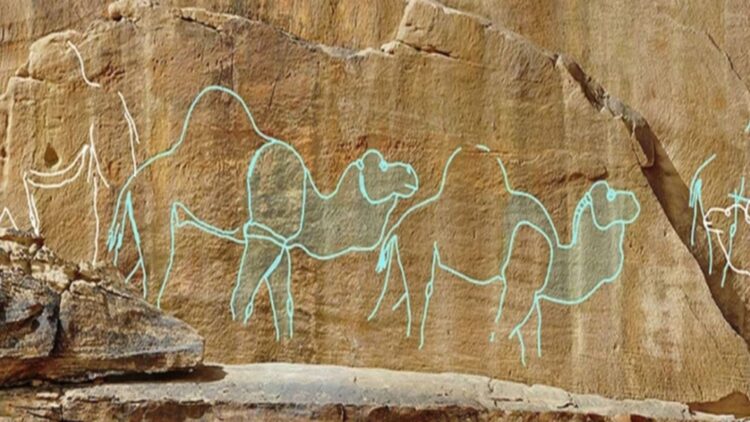
A recent study published in the journal Nature Communications has revealed that ancient artists left behind camel carvings on the cliffs of the Nefud Desert in Saudi Arabia over 12,000 years ago. This significant finding provides new insights into human settlement patterns in the Arabian Peninsula and highlights the cultural connections between early communities.
The discovery includes more than 170 engravings found in three previously unexplored areas: Jebel Arnaan, Jebel Mleiha, and Jebel Misma. The research team, comprising international archaeologists, identified a collection of rock art panels that not only challenges existing timelines for figurative rock art but also points to extensive cultural networks extending 400 kilometers to the Levant.
Uncovering Ancient Artistry
In May 2023, the team focused on locating ancient rock art that had not been included in UNESCO’s World Heritage listings. Their efforts led to the identification of over 60 rock art panels, featuring 130 engravings of large, life-sized animals including camels, goats, donkeys, and gazelles.
According to archaeologist Maria Guagnin, the rock art panel depicts two large camels, one appearing to be in motion and the other walking on the rocky surface. The same layer also yielded artifacts typical of the period, such as small arrowheads and stone beads. Through luminescence dating, the researchers determined that the sediment containing an engraving tool dates back 12,000 years, providing a temporal context for these ancient artists.
Broader Implications for Human History
The implications of this study extend beyond the discovery of rock art. The datings suggest that the creators of these engravings were part of a broader cultural network that utilized similar stone tools and jewelry as their counterparts in the Levant. This connection indicates significant long-range movement among these early communities.
Furthermore, the research revealed that the new sites were once seasonal lakes approximately 15,000 years ago, a stark contrast to the current arid environment of the desert. This change aligns with the return of surface water to Arabia following a period of extreme aridity, suggesting that the conditions for human settlement were more favorable during earlier climatic phases.
The findings challenge previous assumptions about the timeline of human habitation in the region, offering a fresh perspective on the adaptability and resilience of early communities in the face of climatic changes. As researchers continue to explore these areas, further discoveries may emerge, enriching our understanding of ancient human societies in the Arabian Peninsula.