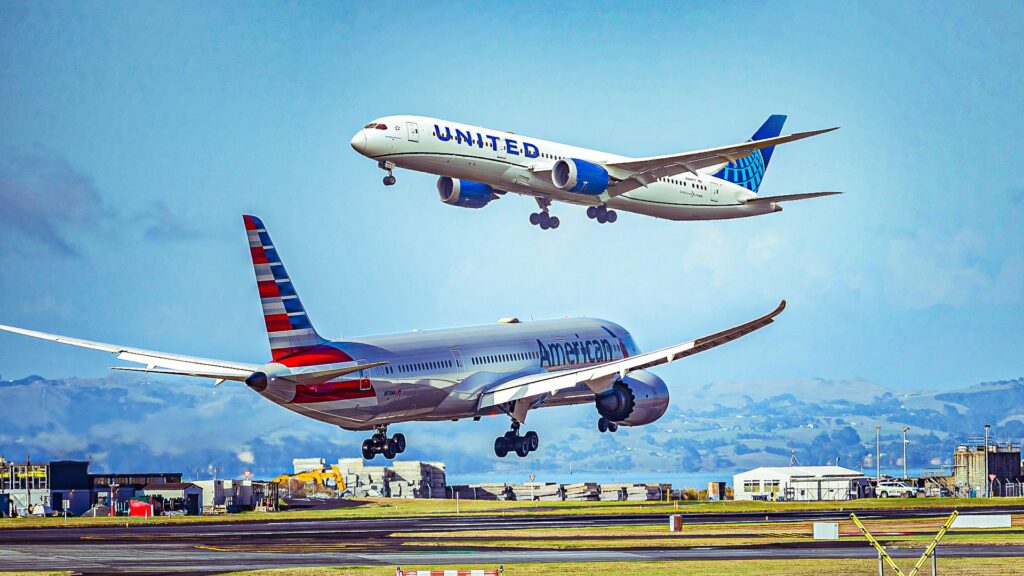
American Airlines has begun operating its newly configured Boeing 787-9s, featuring updated premium seating arrangements. This launch comes shortly before United Airlines introduces its own revamped interiors for future 787 deliveries, with the first aircraft set to enter service in early 2026. The competition between the two major American airlines is heating up as they both aim to enhance the travel experience for their passengers on long-haul flights.
Overview of New Boeing 787-9 Aircraft
American Airlines currently has a fleet of 33 Boeing 787-9s. Among these, 22 are configured in a standard layout, while 11 belong to the “78P” subfleet, showcasing a more premium-heavy configuration that includes 51 Flagship Suites. An additional 20 aircraft are on order, and their fleet numbers begin with 8M, distinguishing them from older models.
In contrast, United Airlines has taken delivery of 48 Boeing 787-9s, all in a standard layout, and anticipates the arrival of its first aircraft in the new “78L” subfleet. This configuration will feature 64 Polaris Suites, marking it as the largest business class cabin among any 787 operators globally. The first of these new aircraft will be designated as N61101 and will operate under fleet number 1101.
Both airlines are implementing new cabin designs and seat models. Notably, they will employ similar seats for their business class and economy offerings. Business class on both airlines features the Elevate Ascent seat, while the economy cabins will utilize the Collins Aspire seat. United Airlines will offer the Collins MiQ for its Premium Plus class, contrasting with American’s choice of the Safran Z535i for its premium economy section.
Comparative Analysis of Cabin Configurations
When assessing which airline offers a more premium experience in its Boeing 787-9, United Airlines emerges as the leader. The new configuration will accommodate just 222 seats, consisting of 64 Polaris Suites, 35 Premium Plus seats, 39 Economy Plus seats, and 84 economy seats. This means that a significant 99 of the seats onboard are classified as premium, which increases to 138 if Economy Plus is included.
In comparison, American’s latest 787-9s feature 51 Flagship Suites and 32 premium economy seats, alongside 18 Main Cabin Extra seats and 143 economy seats. This configuration totals 244 seats, with only 83 categorized as premium, increasing to 101 if Main Cabin Extra is considered. This places American closer to United’s older models rather than its latest offerings.
American Airlines has traditionally taken a conservative approach regarding the size of its premium cabins. For instance, while United’s older 787-9s include 48 Polaris seats, American’s previous models only feature 30 Flagship Business seats. Although the upcoming configuration for the Boeing 777-300ER will include 70 Flagship Suites, United’s 777-300ERs currently have 60 Polaris seats, with no known plans for retrofitting.
United Airlines holds a strong market presence, particularly in cities such as San Francisco, which is a major international hub, and it is also the largest international airline in Washington D.C.. In contrast, American Airlines has its primary hub in Dallas/Fort Worth, which, while significant, does not support the same level of international business travel as some of United’s key markets.
American Airlines is deploying its new 78P subfleet on routes from Chicago and New York to London. This winter, these aircraft will also be flying to destinations such as Paris, Buenos Aires, Auckland, and Brisbane. Meanwhile, United’s 78L routes will include flights from San Francisco to London and Singapore, further emphasizing the competitive landscape of premium international travel.
Both airlines are using their new 787-9s to introduce innovative seating and design standards. American and United are showcasing the Elevate Ascent with suite doors, enhancing passenger privacy. The configurations differ, with American opting for reverse herringbone seating, while United’s design incorporates both reverse herringbone and traditional herringbone layouts, allowing couples to book “honeymoon suites.”
In terms of onboard amenities, United Airlines is set to offer larger screens than American Airlines and a greater number of extra legroom options in economy. While both airlines utilize the Collins Aspire seat in economy, there are notable distinctions in the premium economy offerings, with American choosing the Safran Z535i.
As for Delta Air Lines, it has also been updating its premium offerings, having first unveiled its DeltaOne Suites on the Airbus A350 in 2017. While Delta’s configurations have seen few updates since then, it plans to enhance its Airbus A350-1000 with larger premium cabins and new seating options, although details remain sparse.
As the competition among American, United, and Delta continues to evolve, the introduction of the Boeing 787-9s marks a significant step towards elevating passenger experience in the premium travel sector. Both American and United Airlines are poised to reshape the landscape of long-haul travel with their innovative configurations and offerings.