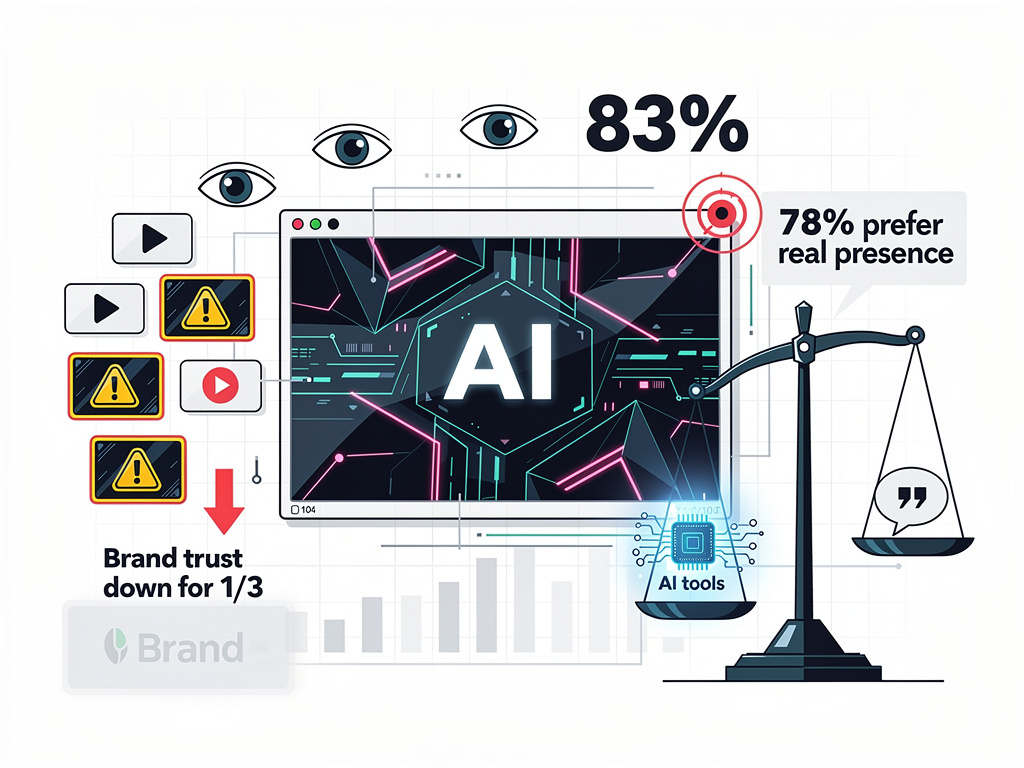
A growing concern among consumers regarding the authenticity of online video content is leading to a notable decline in trust towards brands that utilize artificial intelligence (AI) in their marketing strategies. A survey conducted in September 2025 by video platform Animoto uncovered that approximately 82.6% of U.S. consumers have encountered videos they suspect to be AI-generated. Alarmingly, over a third of these respondents indicated that such suspicions negatively impact their perception of the brand associated with the content.
The findings highlight a significant consumer preference for authenticity, with 77.9% of participants expressing a stronger trust in videos featuring real people compared to those that are faceless or lack a human voice. As Beth Forester, CEO of Animoto, stated, “The data’s clear: consumers are curious about AI, but confident in humans.” She emphasized that while generative AI can enhance video production efficiency, it cannot replace the authenticity that audiences crave.
Many marketers are increasingly adopting AI tools to streamline their video production processes. According to Animoto’s State of Video 2026 report, 84% of marketers are utilizing AI in their video content creation. Nevertheless, an overwhelming 90% of these professionals are making significant edits to the AI-generated outputs to inject brand personality and ensure a human touch. This hybrid approach aims to address concerns from consumers who may feel uneasy about the reliance on AI in marketing.
Consumer Skepticism Driven by Perceived AI Indicators
The skepticism surrounding AI-generated content is fueled by viewers’ ability to identify artificial elements in videos. The Animoto study revealed that 67% of respondents noted robotic movements, 55% detected unnatural voice patterns, and 51% felt a lack of emotional depth in such videos. Respondents like Olga Mirkovic described AI-generated content as “a failure to fit into the real context,” while Aaliyah Miller remarked that AI videos possess “a look and feel that tells you it is AI,” lacking the engagement that comes with authentic human content.
This distrust extends beyond video platforms. A separate analysis by Forbes of a Nielsen study from 2024 found that 55% of respondents felt uncomfortable with AI-heavy websites, and 48% expressed distrust towards brands that advertise on these platforms. Among specific demographics, such as Black and Native American respondents, concerns regarding bias significantly influenced their perceptions of AI-driven marketing.
The push for transparency and cultural relevance has become increasingly crucial, with Nielsen’s Patricia Ratulangi asserting that brands must prioritize these elements to regain consumer trust. Broader surveys indicate that 52% of consumers are apprehensive about undisclosed AI usage in brand communications, as noted in a report by Sprout Social.
Consequences of Distrust on Marketing Strategies
The negative impact of AI labeling on brand perception is stark. A study from the Nuremberg Institute, referenced by KO Insights, revealed that advertisements identified as AI-generated are perceived as less natural, leading to decreased research and purchase intent among consumers. Additionally, a survey by Deloitte found that 70% of respondents harbored fears of being misled by AI-generated content.
The consequences of consumer distrust are evident in the marketing realm, with brands like McDonald’s Netherlands retracting an AI-generated Christmas advertisement after receiving backlash. Similarly, Coca-Cola faced criticism for its AI-driven holiday campaign, which was deemed gimmicky. As Kate O’Neill articulated in KO Insights, “AI produces output that is statistically likely… but that’s not genuinely meaningful.” Consumers are evidently seeking a genuine connection, particularly in emotional contexts.
Surveys conducted by YouGov in December 2025 revealed that only 5% of consumers fully trust AI recommendations, while 41% outright distrust such suggestions. Research from iHeartMedia further indicated that a significant number of people oppose AI in entertainment despite its widespread use, highlighting a growing demand for transparency in content creation.
Marketers are adjusting their strategies to strike a balance between AI efficiency and human touch. Feedback from Animoto users indicated a growing aversion to AI-generated voices, which many likened to “pre-recorded messages” that diminish trust. As Roya Safarian advised, “AI can enhance storytelling as long as the brand still keeps a human touch.”
The demand for brand reflection in AI outputs remains high, with 95% of marketers emphasizing the need for personality infusion in their content. As articulated by Lucas Killcoyne from Animoto, the goal should be to avoid simply generating videos without forming a meaningful connection with audiences.
As AI technology continues to evolve, brands must prioritize authenticity and human elements in their marketing strategies. The implications are clear: as consumer skepticism grows, brands that prioritize real faces and genuine connections are more likely to thrive in a landscape where trust is paramount.
Regulatory changes are also on the horizon, with new EU rules mandating AI labeling. According to a Pew Research study conducted in September 2025, most Americans express a desire for tools that distinguish between human and AI-generated content but remain doubtful about their detection capabilities. Social media discussions indicate an impending shift towards increased scrutiny of AI content.
In a market that increasingly values authenticity, brands risk alienation if they fail to adapt. As Farrukh Kamran noted, video’s power lies in its ability to convey emotions and foster connections. The future will likely favor brands that can successfully blend AI capabilities with human creativity, ensuring they resonate with an audience increasingly wary of synthetic content.