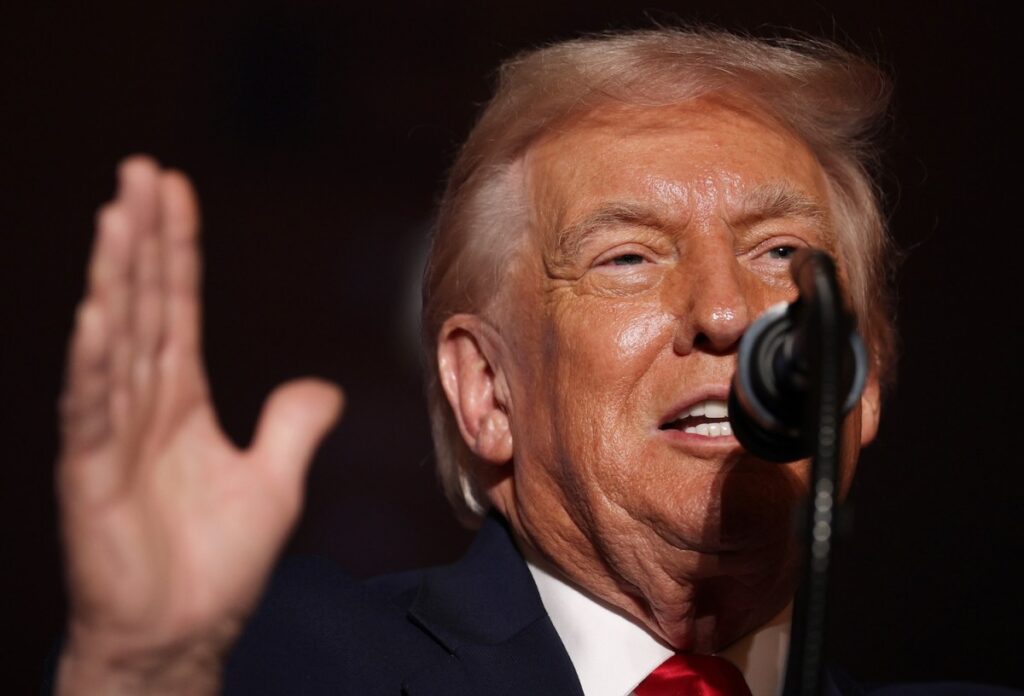
UPDATE: During a fiery speech in Mount Pocono, Pennsylvania, on July 25, 2023, President Donald Trump made headlines by praising North Korea’s border security as “one of the strongest borders anywhere in the world.” He emphasized this point by describing a formidable barrier of “seven walls of wire” electrified with “a million volts,” while simultaneously claiming that the U.S. has achieved its “tightest border we’ve ever had.”
This urgent announcement comes as Trump intensifies his critique of former President Joe Biden’s immigration policies. He alleged that under Biden, “25 million people came into our country… mostly across our southern border,” and stated that his administration had “inherited the worst border in the history of the world.”
Trump’s remarks highlight his long-standing focus on border security, which he has branded as a central theme of his political identity. He asserted that the current U.S. border policy is the most stringent in history, stating, “for seven months in a row, we’ve had zero illegal immigrants admitted to the United States.” However, this claim has been challenged by recent data from U.S. Customs and Border Protection (CBP), showing significant encounters at the southern border despite claims of zero admissions.
Trump’s unusual praise for North Korea’s heavily fortified border comes amid increasing tensions along the Demilitarized Zone (DMZ). Recent satellite imagery indicates that North Korea is reinforcing its defenses, building new barriers, and laying mines, raising concerns about a potential escalation in conflict.
“North Korea has a stronger border. There’s one country that probably has a stronger border. North Korea has seven walls of wire. And each of them has a million volts of electricity going through it,” Trump stated, adding that breaching such a barrier would be fatal.
As Trump continues to draw comparisons between U.S. and North Korean border security, experts warn of the growing threat posed by North Korea. Analysts suggest that Kim Jong Un’s regime is enhancing its military capabilities, increasing the risk of regional conflict. Trump’s comments reflect a strategic narrative linking domestic border security to international relations, positioning both as critical to national safety.
In response to Trump’s claims, a spokesperson for the White House commented on the administration’s focus on immigration, stating, “The tremendous success on U.S. immigration policy – from closing the border to deporting criminal illegal aliens – is all thanks to President Trump’s vision.” Meanwhile, former intelligence officials express concern over the evolving military posture of North Korea and the potential for renewed aggression.
Moving forward, Trump’s remarks raise critical questions about the future of U.S. border policy and its implications for international diplomacy. As he continues to advocate for stringent immigration measures, the geopolitical landscape remains precarious, with North Korea’s actions potentially influencing U.S. foreign policy.
This urgent development underscores the intertwining nature of domestic and foreign policy narratives, with Trump positioning U.S. immigration issues alongside international security threats. As tensions rise, both at home and abroad, the discourse surrounding border security is set to remain at the forefront of political discussions.
Stay tuned for more updates on this evolving story as the implications of Trump’s statements and the situation in North Korea unfold.