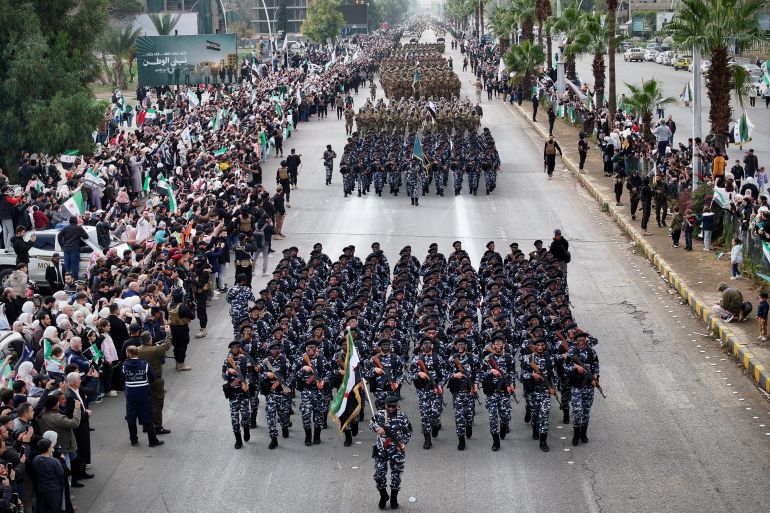
UPDATE: Syria’s interim government is in a race against time to rebuild its military capabilities after the dramatic collapse of Bashar al-Assad’s regime on December 8, 2024. As the nation grapples with internal strife and external threats, the newly appointed Defence Minister Murhaf Abu Qasra announced critical steps toward restructuring the armed forces, emphasizing a shift in military doctrine to prioritize loyalty to the nation.
During a ceremony in Aleppo, Minister Abu Qasra stated, “We started the process of restructuring our military and army… to build an army that represents Syria and is able to face the challenges.” This urgent initiative comes after the Assad regime’s security apparatus crumbled, leaving a void filled by various armed factions, including the influential Hay’at Tahrir al-Sham (HTS), which boasts around 40,000 fighters.
However, analysts warn that rebuilding Syria’s military is far from straightforward. The process is complicated by the need to vet a large influx of recruits and integrate diverse armed groups into a cohesive national army. “If Syria fails to integrate all armed forces and former opposition groups into its army, it risks fragmentation and disintegration,” cautioned Caroline Rose, director at the New Lines Institute.
In the immediate aftermath of the regime’s fall, Israel intensified military operations, conducting over 600 attacks on Syrian territory, crippling much of the country’s military infrastructure. “With Israel having destroyed much of Syria’s conventional military capabilities, the new Syrian Army is starting from scratch,” Rose added.
President Ahmed al-Sharaa has dissolved the previous military structure and appointed new commanders, but challenges loom large. The recruitment drive has attracted thousands of young men due to limited economic opportunities, raising concerns about the vetting process. “It’s a delicate balance to keep Syria’s security intact,” stated Samy Akil from the Tahrir Institute.
Significantly, foreign fighters who previously opposed Assad’s regime cannot hold key military positions, a stipulation highlighted by the U.S. government. President al-Sharaa reiterated that foreign fighters will not pose a threat to their countries and will not take on significant roles.
Moreover, there remains a substantial gap in seasoned military personnel. Reports indicate that approximately 70,000 Alawite officers from the Assad era are unlikely to be reinstated, exacerbating the military’s capability shortage. Meanwhile, factions loyal to former regime figures, such as Rami Makhlouf, are reportedly attempting to establish their own armed groups, posing potential threats to governmental stability.
While Syria’s military rebuild is underway, international dynamics are shifting. Under al-Sharaa, Syria has gained support from countries like Saudi Arabia and Qatar, previously opposed to Assad, marking a significant change in diplomatic relations. Additionally, al-Sharaa’s visit to the White House in November highlights warming ties with the United States.
Despite this increased international backing, the Syrian military’s reliance on Russian equipment complicates its operational independence. “The biggest challenge the Syrian Army faces is that it is essentially a Russian force in its doctrine and equipment,” noted Rob Geist Pinfold from King’s College London. U.S. support may also influence military capabilities, especially in intelligence-sharing to combat a potential resurgence of ISIS.
As the Syrian government moves to integrate various factions, building trust among minority communities remains critical. Historical sectarian violence has left deep scars, and many non-Sunni groups view the Syrian army as a sectarian militia rather than a national force. “Opinion polls suggest most Sunni Arab Syrians still trust the army, but minority communities do not,” Geist Pinfold pointed out.
The integration of the Kurdish-led Syrian Democratic Forces (SDF) into the national military by the end of 2025 is another key development to watch. However, rising tensions and clashes between the SDF and government forces signal that the path to unity may be fraught with challenges.
As the Syrian government navigates these complex dynamics, the successful rebuilding of its armed forces will be crucial for national stability and attracting foreign investment. The world watches closely as Syria attempts to heal its fractured military landscape amidst ongoing threats and urgent needs.