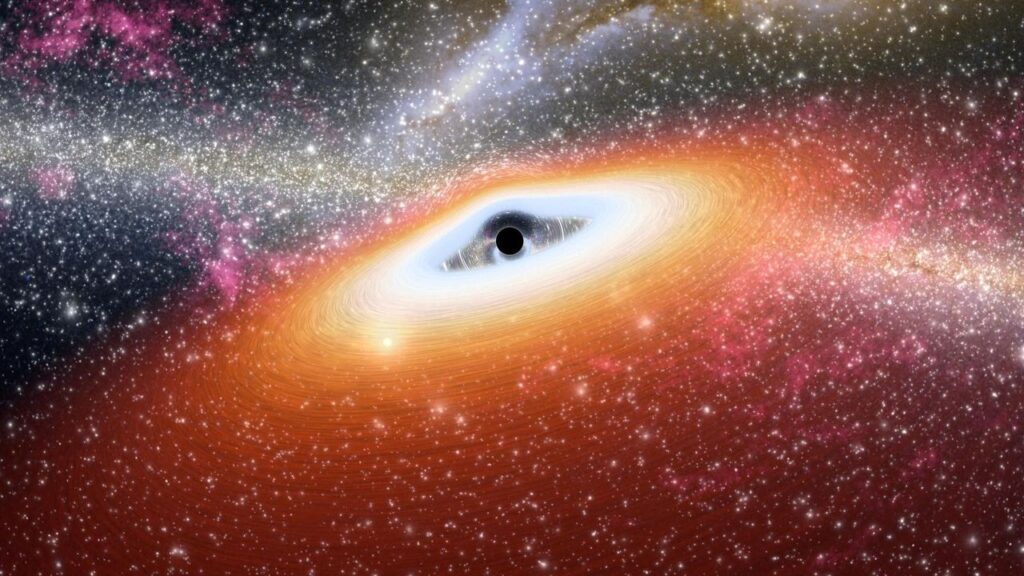
BREAKING: New revelations regarding black holes are reshaping our understanding of the universe, thanks to a groundbreaking paper published by Stephen Hawking on March 1, 1974. The physicist’s work, titled “Black hole explosions?”, fundamentally altered the concept of black holes, suggesting they can emit radiation and potentially evaporate over time.
This pivotal discovery challenges previous beliefs that black holes are eternal traps from which nothing can escape. Hawking’s findings indicate that black holes might shrink due to a process known as Hawking radiation, leading to their eventual evaporation, an idea that has generated excitement and debate in the scientific community.
In his brief but impactful paper, Hawking combined elements of general relativity, thermodynamics, and quantum mechanics. He proposed that pairs of “virtual” particles frequently pop in and out of existence near a black hole. When one particle falls into the black hole while the other escapes, it carries away a minuscule amount of heat. This process, according to Hawking, could eventually lead to the black hole’s destruction.
Hawking famously noted that while a black hole’s explosion might seem small on an astronomical scale, it is equivalent to about 1 million 1 Mton hydrogen bombs. This dramatic assertion has profound implications for our understanding of cosmic phenomena.
Despite the compelling nature of Hawking’s theory, it also introduced a significant paradox: if black holes evaporate, does that mean information that falls into them is lost forever? This dilemma contradicts a fundamental principle of quantum mechanics—that information cannot be created or destroyed. For decades, Hawking and other physicists have been grappling with this issue, leading to ongoing research and debate.
In a public lecture in 2015, Hawking reiterated his belief that information could potentially escape a black hole, possibly through a wormhole. “Black holes ain’t as black as they are painted,” he stated. “They are not the eternal prisons they were once thought to be.” This perspective has sparked discussions about the nature of the universe and the possibilities of parallel worlds.
After Hawking’s passing in 2018, his collaborators continued to explore these theories, suggesting that information swallowed by black holes might not be lost but could instead be released back into the universe. In a significant development, physicists in 2024 proposed that traces of this information could manifest as subtle ripples in the fabric of space-time, detectable through gravitational waves—an area of active research and observation.
While no direct evidence for black hole explosions or primordial black holes has been found, recent discoveries from the James Webb Space Telescope have hinted at the existence of ancient galaxies that might be explained by these elusive cosmic entities.
This revolutionary understanding of black holes not only impacts theoretical physics but also captures the imagination of scientists and the public alike. As research continues, the implications of Hawking’s work remain profound, inviting further exploration into the mysteries of our universe.
Stay tuned for updates as scientists dig deeper into the implications of Hawking’s theories and the ongoing quest to unravel the secrets of black holes. This is a developing story with potential ramifications for our understanding of physics and the cosmos.