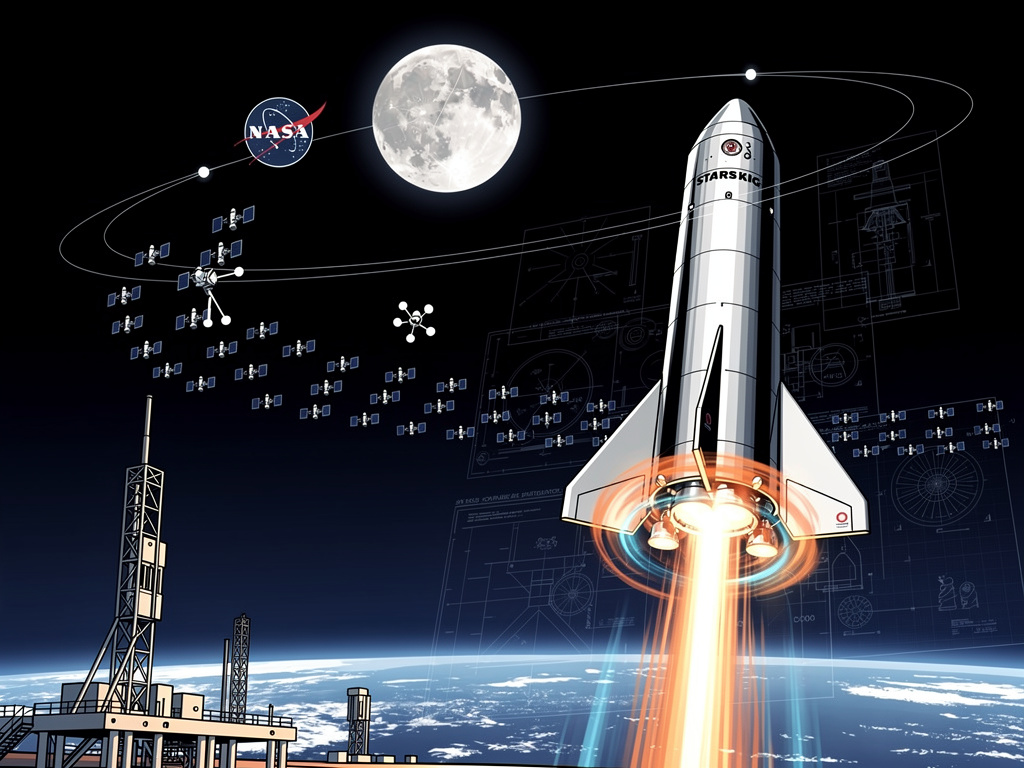
SpaceX is on the brink of a pivotal moment as it prepares for the fourth integrated flight test of its Starship rocket. This mission, set to take place off the Texas coast, is crucial not only for the company but also for NASA’s lunar ambitions and the broader economics of space access. Following a successful third flight in March 2023, which saw Starship reach orbital velocity before being lost during reentry, the primary goal for this upcoming attempt is to achieve a controlled and safe reentry.
Challenges of Reentry and Rapid Development
The loss of both the Super Heavy booster and the Starship upper stage during the previous test underscored the complexities of atmospheric return. For the fourth flight, SpaceX aims to demonstrate that the vehicle can survive the intense conditions of reentry. Elon Musk emphasized this goal, stating, “Main goal of this flight is to get through max reentry heating” on X, the social media platform he owns. Success would validate the effectiveness of the Starship’s heat shield tiles, which must withstand temperatures exceeding 2,700 degrees Fahrenheit, while maintaining stability through its large flight-control flaps.
Proving the capability of Starship to return safely is not merely an engineering challenge; it is central to the business model of SpaceX. The company envisions a future where both the Super Heavy booster and the Starship upper stage can be reused hundreds or even thousands of times with minimal refurbishment. This level of reusability is essential for lowering costs and enabling more frequent launches.
Production Innovations at SpaceX
At the Boca Chica facility in Texas, SpaceX employs a production model reminiscent of automotive manufacturing rather than traditional aerospace practices. This approach allows the company to construct new rockets in parallel, facilitating rapid learning and adaptation after each test. The hardware designated for the fourth flight, identified as Booster 11 and Ship 29, incorporates numerous upgrades based on insights gained from prior missions.
This aggressive testing philosophy contrasts sharply with government-led aerospace programs, which often require years and substantial funding to develop a single vehicle. SpaceX’s willingness to embrace real-world testing has accelerated its development timeline, a strategy evident from the Falcon 9 missions to the ongoing Starlink project.
Despite the rapid pace of production, the test schedule remains subject to regulatory oversight from the Federal Aviation Administration (FAA). Each launch necessitates a formal license, and incidents like the vehicle losses from the third flight trigger mandatory investigations. The FAA recently concluded its inquiry into the IFT-3 flight, outlining necessary corrective measures and subsequently granting the launch license for the upcoming test.
Implications for NASA and Future Ventures
The urgency surrounding the Starship program is amplified by SpaceX’s $2.9 billion contract with NASA for the Artemis program, aimed at returning astronauts to the Moon by late 2026. NASA’s entire lunar mission strategy relies on the successful operationalization of Starship. Delays in the testing process create a ripple effect that could jeopardize the timeline for lunar exploration.
Additionally, Starship is integral to the deployment of the next-generation Starlink satellites, essential for expanding the satellite internet constellation. While the Falcon 9 has successfully launched thousands of early satellites, the larger Starlink V2 satellites require Starship for deployment. The growth of Starlink, which has already reached a cash-flow positive state, is closely tied to the success of the Starship program.
In a broader context, the fourth flight of Starship represents a critical test of SpaceX’s ambitions. If the company can master reusability at this scale, it could revolutionize access to space, reducing launch costs significantly. This transformation could enable a range of advancements, from large-scale space telescopes to rapid cargo delivery on Earth, and ultimately support Elon Musk’s vision for Mars colonization.
The upcoming launch is not just another test; it serves as a live demonstration of SpaceX’s engineering philosophies and industrial capabilities. A successful reentry could signify that the company is close to solving one of the most challenging aspects of rocket reusability. Conversely, another failure would likely lead to further delays and regulatory scrutiny, extending the timeline before Starship can fulfill its potential as a transformative force in space exploration.