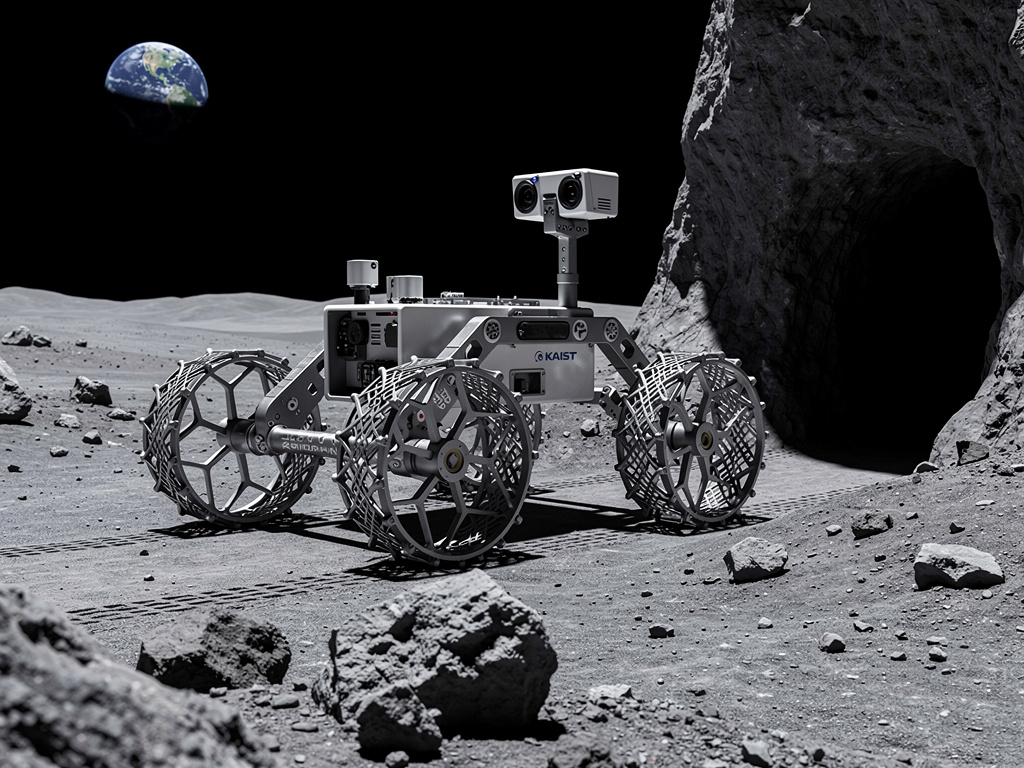
UPDATE: South Korea is making headlines with a revolutionary lunar rover prototype designed to navigate the moon’s most challenging terrains. The Korea Advanced Institute of Science and Technology (KAIST) has unveiled a rover equipped with innovative morphing wheels that expand and contract, enabling it to conquer rugged lunar landscapes. This breakthrough comes as nations intensify their lunar exploration efforts, underscoring South Korea’s commitment to advancing its space program.
The newly developed rover features airless wheels crafted from elastic carbon steel strips, allowing for dynamic shape-shifting capabilities. These wheels can compress to navigate narrow passages and expand to traverse uneven ground, absorbing impacts from drops. This flexibility is crucial for exploring lunar caves, which are potential sites for future human habitation, offering protection from cosmic radiation and extreme temperatures.
Researchers have rigorously tested the rover on Earth, simulating lunar conditions by deploying it in actual caves and subjecting it to extreme temperatures and impacts. According to the KAIST team, these wheels outperform traditional designs, providing enhanced durability and adaptability in the harsh lunar environment.
This innovation arrives at a pivotal moment for South Korea, following the successful launch of its first lunar orbiter, Danuri, in 2022. The orbiter has already provided stunning imagery of the moon’s shadowed regions, and now, the KAIST rover aims to facilitate ground-level reconnaissance in areas inaccessible to larger vehicles.
The construction of these morphing wheels is a significant advancement in materials science. The lightweight yet robust carbon steel ensures that the rover can withstand the moon’s harsh conditions without unnecessary weight. “The wheel could absorb impacts and navigate uneven terrain while remaining robust under extreme lunar conditions,” the KAIST paper emphasizes, highlighting its resilience against lunar dust and temperature extremes.
As South Korea continues to carve its niche in space exploration, the potential for this rover technology to integrate into larger mission architectures is profound. The KAIST team envisions deploying multiple smaller rovers as part of a mothership strategy, reminiscent of NASA’s Artemis program, where robotic precursors lay the groundwork for human exploration.
The excitement surrounding lunar robotics is palpable, with discussions on social media platforms like X showcasing the potential of such flexible mobility solutions. Enthusiasts are particularly interested in the rover’s ability to scout for resources like water ice, crucial for future lunar missions.
In the context of global space exploration, South Korea’s advancements align with its national strategy for independent space capabilities. The government has requested a substantial budget of $459 million for a robotic lander, signaling its commitment to pioneering lunar exploration technologies.
Challenges remain, notably the notorious lunar regolith that poses risks to mechanical systems. However, the woven structure of the KAIST wheels is designed to flex rather than grind, mitigating potential failures. Long-term testing in simulated lunar conditions will be essential to validate this innovative design.
In a rapidly evolving competitive landscape, South Korea’s space agency, KARI, is looking to integrate this rover into future missions, potentially collaborating with international partners like China and NASA. The recent excitement around lunar mining and resource utilization underscores the urgency of developing effective robotic systems for these endeavors.
As KAIST prepares for vacuum chamber tests to replicate lunar conditions, the implications of this technology extend beyond the moon. The rover’s design could inspire future missions to Mars or asteroids, demonstrating the versatility of this groundbreaking innovation.
Looking ahead, South Korea’s focus on exploring lunar caves could pave the way for a sustainable human presence on the moon. Insights from the Danuri orbiter are expected to guide rover deployments into these critical areas, where resources may lie hidden.
As the world watches South Korea’s lunar ambitions unfold, the KAIST morphing wheel rover represents a significant leap in robotic exploration technology. This development not only showcases engineering ingenuity but also emphasizes the growing importance of international collaboration in space exploration.
With nations racing to unlock the moon’s secrets, South Korea’s latest advancements are set to transform how we explore extraterrestrial environments, making a compelling case for the future of lunar exploration.