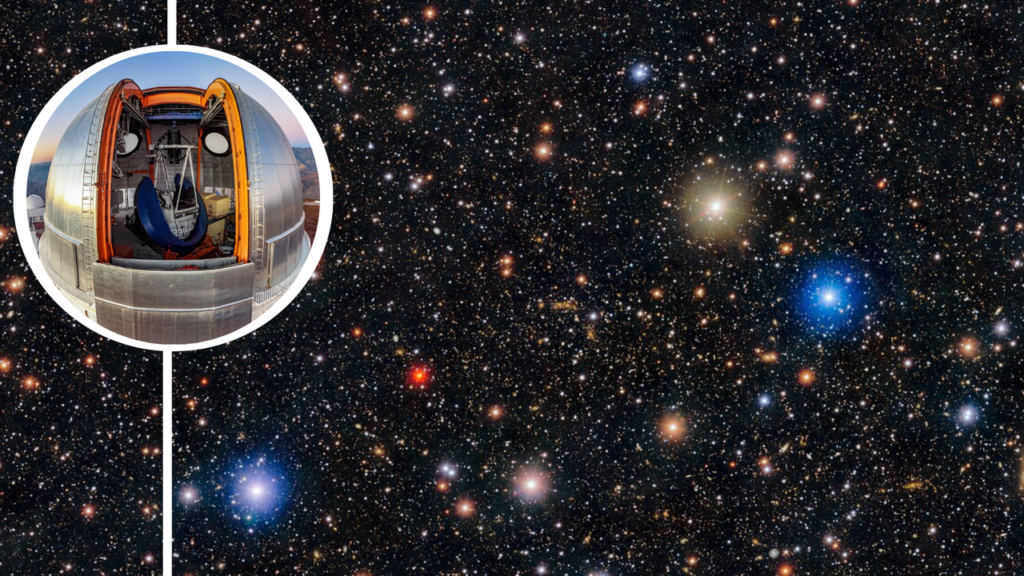
Recent research has provided scientists with unprecedented insights into the expansion of the universe and the enigmatic force known as dark energy. This achievement follows the analysis of six years of data from the Dark Energy Camera (DECam), which is part of the U.S. National Science Foundation’s Víctor M. Blanco 4-meter telescope. The Dark Energy Survey (DES) Collaboration collected this data over 758 nights, covering one-eighth of the sky between 2013 and 2019, capturing information from approximately 669 million galaxies located billions of light-years away from Earth.
This groundbreaking analysis unites four distinct methods of studying dark energy for the first time, significantly enhancing our understanding of this mysterious phenomenon that constitutes about 68% of the universe’s total energy and matter. According to Regina Rameika, Associate Director for the Office of High Energy Physics at the Department of Energy’s Office of Science, “These results from DES shine new light on our understanding of the universe and its expansion.” The findings have doubled the constraints on dark energy’s effects, marking a crucial step towards unraveling its true nature.
Understanding Dark Energy and Its Discovery
The concept of dark energy first emerged in 1998 when astronomers observed distant supernovas. They discovered that galaxies farther from Earth were receding at an accelerated rate, confirming that the universe is expanding, a notion first proposed by Edwin Hubble more than a century ago. This phenomenon raised profound questions about what drives this acceleration, leading to the term “dark energy” as a placeholder for the unknown force behind it.
In the 28 years since its initial discovery, research has shown that dark energy’s influence became dominant between 3 and 7 billion years after the Big Bang, overpowering the gravitational pull of matter. Given its significant role in the cosmos, scientists have been eager to learn more about its properties and origins.
The recent analysis utilized Type Ia supernovas—similar to those that first indicated the existence of dark energy—alongside three other cosmic probes: weak gravitational lensing, galaxy clustering, and baryon acoustic oscillations. These diverse methods enabled the Dark Energy Survey team to reconstruct the distribution of matter over the past six billion years, offering fresh perspectives on cosmic expansion.
Implications of the New Findings
The DES results align closely with the standard model of cosmology, known as the Lambda Cold Dark Matter (LCDM) model, which posits that dark energy remains stable over time. The study also supports the extended model (w CDM), which allows for the evolution of dark energy. However, the research identified discrepancies regarding how matter clusters in the modern universe compared to predictions made by both models. Observations revealed that current galaxies do not cluster as either model suggests, highlighting a significant gap between theoretical expectations and empirical data.
The next phase for the Dark Energy Survey involves integrating DECam data with observations from the upcoming Vera C. Rubin Observatory, which aims to survey approximately 20 billion galaxies over the next decade. Chris Davis, National Science Foundation Program Director, emphasized the potential impact of this collaboration, stating, “Rubin’s unprecedented survey of the southern sky will enable new tests of gravity and shed light on dark energy.”
The team’s findings have been submitted to the journal Physical Review D and are also available on the repository site arXiv. As researchers continue to investigate the universe’s mysteries, this latest analysis underscores the importance of long-term investment in scientific research and the potential for collaborative efforts to yield transformative insights.