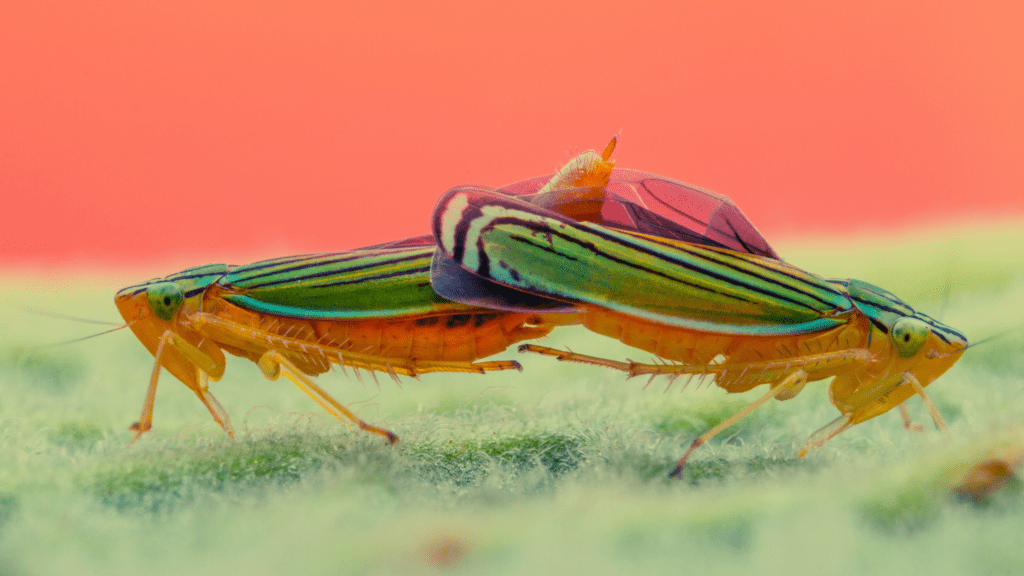
BREAKING: Scientists at Penn State have successfully replicated the remarkable camouflage ability of leafhoppers, common insects known for their near-invisibility. This groundbreaking research, published in ACS Nano, unveils a potential game-changer across multiple industries, with implications for energy devices, military camouflage, and even biomedical applications.
Leafhoppers employ a unique method to evade predators by coating themselves in microscopic particles that significantly reduce glare, making them nearly undetectable to animals that rely on reflected light. The Penn State team has now recreated this effect in a laboratory setting, revealing the intricate mechanisms behind this natural marvel.
The study focuses on structures known as brochosomes—tiny, hollow particles produced by leafhoppers. These particles, resembling mini soccer balls, are meticulously arranged with holes that scatter light, achieving a remarkable glare reduction of 80 to 96 percent across both visible and ultraviolet light spectra. This significant reduction eliminates the telltale flashes that could expose the insect to predators.
Using a novel chemical approach, researchers developed a microfluidic system capable of producing over 100,000 particles per second, far surpassing traditional nanofabrication methods. By creating microscopic droplets of dissolved polymers suspended in water, and allowing the solvent to evaporate, the polymers are drawn into hollow spheres that mimic the natural brochosomes found on leafhoppers.
The team’s innovative process allows for precise control over both the size and shape of the particles. Five distinct brochosome designs have been successfully recreated, with sizes ranging from a few hundred nanometers to approximately two micrometers. Some designs even replicate the pentagon and hexagon patterns observed in nature.
The implications of this research are vast. Surfaces engineered to reflect less light could vastly improve the efficiency of energy technologies and enhance optical materials through superior glare control. Military applications, particularly in camouflage technology, are also on the horizon, although the researchers emphasize that practical uses will necessitate further testing.
Moreover, the study hints at potential biomedical applications, including drug delivery systems that leverage the unique shapes and surface properties of these particles. However, this aspect remains largely unexplored at this time.
What makes this research particularly captivating is its origin: a seemingly ordinary backyard insect has evolved a sophisticated mechanism for managing light, which scientists are now learning to replicate at scale. As the world looks for innovative solutions to modern challenges, the ability to harness nature’s designs could pave the way for advancements that benefit various sectors.
Stay tuned for further updates on this exciting development, as the science community continues to explore the applications of these remarkable findings.