UPDATE: Russia and Iran have just announced a significant acceleration in the development of the International North-South Transport Corridor (INSTC), a crucial multimodal trade network that promises to connect Northern Europe with South Asia. This urgent push aims to enhance trade efficiency and reduce dependency on vulnerable maritime routes, marking a pivotal moment in regional logistics.
The INSTC is poised to serve as a strategic lifeline for Russian exports, allowing goods and energy to bypass the increasingly perilous maritime paths through the Black Sea, Suez Canal, and Red Sea. With logistical constraints mounting, Moscow’s latest move is critical for securing trade relationships, particularly with India, which seeks to boost trade to $400 billion by 2025.
Earlier today, Ali Larijani, secretary of Iran’s Supreme National Security Council, met with Russian Deputy Prime Minister for Transport Vitaly Savelyev in Tehran to discuss expedited steps toward full operation of the corridor. Larijani stated, “This project is a strategic priority,” emphasizing Iran’s commitment to completing the INSTC and solidifying its role as a central hub in Eurasian trade.
The corridor allows Russian cargo to travel by rail to Azerbaijan’s Baku port, cross the Caspian Sea, and proceed through northern Iran on the Rasht-Astara railway, ultimately reaching Bandar Abbas on the Persian Gulf. This route significantly reduces transit times to India, making it an attractive alternative for exporters facing sanctions and geopolitical tensions.
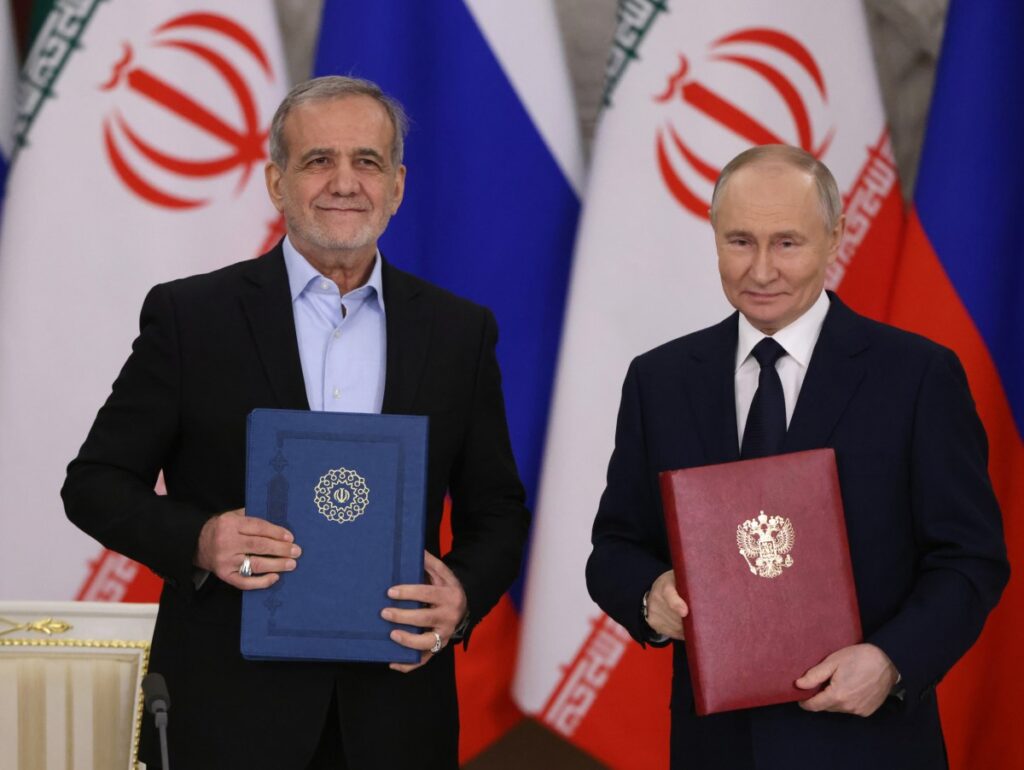
In a separate meeting, President Vladimir Putin pressed Iranian Parliament Speaker Masoud Pezeshkian for updates on the critical 162.5-kilometer segment of the railway. Pezeshkian assured Putin of his close oversight, stating, “I follow this project every week,” highlighting its importance to both nations.
The INSTC combines various transport methods, including rail, road, and maritime routes through Kazakhstan, Turkmenistan, and Azerbaijan. It is designed to connect Russia’s northern cities directly to Indian ports, slashing transit times by nearly half compared to the Suez Canal.
While the INSTC has faced delays in past decades due to overreliance on oil revenues and regional opposition, momentum has surged recently. Currently, over 106 kilometers of the Rasht-Astara line are complete, with leaders in Moscow and Tehran closely monitoring ongoing progress.
The United States has expressed concerns regarding the growing influence of the INSTC, warning that increased Iranian control could undermine sanctions enforcement and shift regional power dynamics. U.S. officials are actively tracking developments as the corridor evolves.
Looking ahead, the INSTC could potentially integrate with East-West routes to China and Europe, creating a comprehensive Eurasian rail and shipping network. For Russia, this corridor represents a durable alternative to constrained maritime routes, while for Iran, it transforms geographical positioning into significant economic and strategic advantage.
As Russia and Iran accelerate their collaboration on the INSTC, the implications are vast, reshaping not just logistics but also global trade dynamics. Observers are keenly watching how these developments unfold, highlighting the urgent need for Western powers to reassess their strategies in response to this emerging trade corridor.