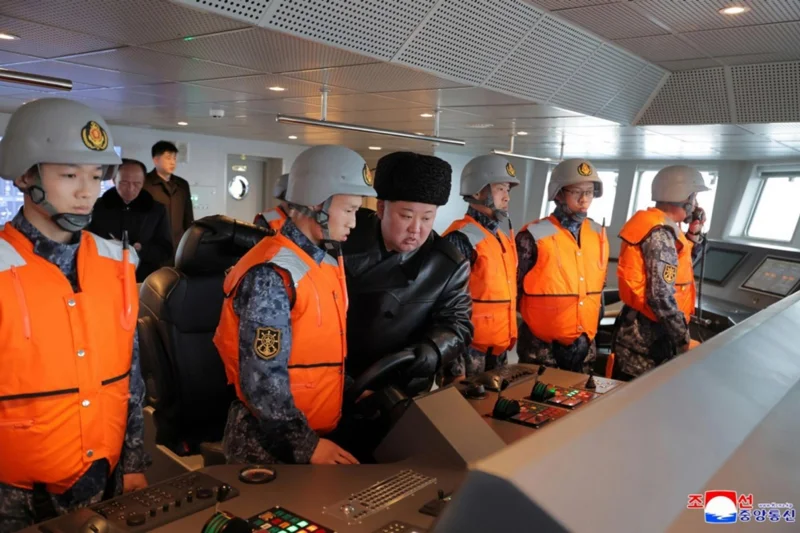
UPDATE: North Korea is intensifying its nuclear ambitions in response to recent U.S. and Israeli airstrikes on Iran, raising alarming concerns about regional security. Just hours ago, state media confirmed that leader Kim Jong Un observed missile tests aboard the newly launched 5,000-ton destroyer Choe Hyon, indicating a significant escalation in military preparations.
During inspections on March 6 and 7, Kim reported that the navy’s nuclear armament program is “being carried out satisfactorily,” underscoring the nation’s commitment to integrating nuclear capabilities into its naval forces. Images broadcasted by North Korean state television revealed multiple launches of Hwasal series missiles, which North Korea claims can be equipped with tactical nuclear warheads.
The International Atomic Energy Agency (IAEA) has also flagged ongoing nuclear developments, noting that uranium enrichment facilities at Yongbyon and Kangson remain operational. Reports indicate the completion of a new nuclear facility at Yongbyon, heightening fears about North Korea’s expanding nuclear arsenal, which is estimated to exceed 100 nuclear warheads.
Military analysts emphasize that North Korea’s focus on submarine-launched ballistic missiles is particularly troubling. These systems provide a more elusive nuclear deterrent, making it increasingly difficult for adversaries to detect and intercept potential threats. The recent U.S.-Israel strikes, which reportedly eliminated key Iranian leaders, are believed to have reinforced North Korea’s perception that nuclear capabilities are crucial for regime survival.
The implications of these developments extend beyond North Korea. South Korea, already on high alert, may find its goal of denuclearization increasingly unattainable. There are rising calls for the South Korean government to reconsider parts of the 2018 inter-Korean military agreement that imposed limits on surveillance operations near the border. Critics argue that such restrictions could hamper South Korea’s intelligence-gathering capabilities at a critical juncture.
Security experts stress the need for South Korea and its allies to adapt to these evolving threats. They advocate for enhancing cyber capabilities and electronic warfare tools that could neutralize missile launch systems before they can be deployed. The lessons of recent conflicts, where advanced intelligence and AI-driven technologies played pivotal roles, cannot be overlooked.
As tensions escalate, the international community watches closely. The urgent need for strategic responses from South Korea and its allies has never been more critical. The developments in North Korea’s nuclear program signal a turning point that could reshape security dynamics across the region.
Stay tuned for further updates on this rapidly evolving situation, as the implications of North Korea’s nuclear ambitions become increasingly profound.