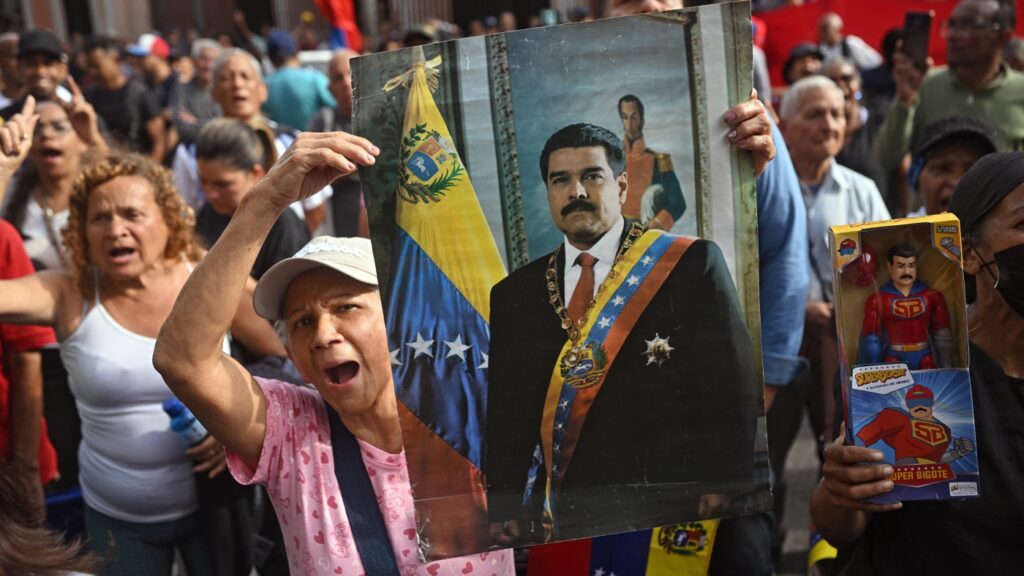
A woman holds a portrait of Venezuelan President Nicolas Maduro during a gathering in Caracas on January 3, 2026, after US forces captured him. President Donald Trump said Saturday that US forces had captured Venezuela's leader Nicolas Maduro after bombing the capital Caracas and other cities in a dramatic climax to a months-long standoff between Trump and his Venezuelan arch-foe. (Photo by Federico PARRA / AFP via Getty Images)
UPDATE: The criminal prosecution of former Venezuelan President Nicolás Maduro is advancing rapidly following his arrest on U.S. soil. During his initial court appearance in Manhattan on July 15, 2023, Maduro pleaded not guilty to serious charges including narco-terrorism conspiracy and cocaine-importation conspiracy. His wife, Cilia Flores, who was captured alongside him during a dramatic raid in Caracas, also entered a not guilty plea.
U.S. Attorney General Pam Bondi asserted on social media over the weekend that Maduro and Flores “will soon face the full wrath of American justice on American soil in American courts.” This marks the beginning of what could be a prolonged legal battle involving pretrial motions, possible plea negotiations, and a jury trial for Maduro, who ruled Venezuela for over a decade.
Legal experts anticipate that Maduro’s status as a former head of state will be a significant point of contention in court. Two former federal prosecutors indicated that his defense may argue he cannot be criminally charged for actions taken while in office. The case is being led by attorney Barry Joel Pollack, who has not yet commented on the charges. Flores is represented by attorney Mark Donnelly, who stated they are “looking forward to reviewing and challenging the evidence.”
Since 2019, the U.S. has not recognized Maduro as the legitimate president of Venezuela due to allegations of a fraudulent election. The indictment claims that Maduro’s drug trafficking activities date back to 1999, even before he became president. Notably, there is historical precedent for U.S. courts prosecuting foreign leaders, as seen in the case of Panamanian dictator Manuel Noriega, who lost his claim to head-of-state immunity in the early 1990s.
During his court appearance, Maduro declared himself both the president of Venezuela and a “prisoner of war,” raising questions about the legality of his arrest. His capture, executed by U.S. forces during a surprise incursion, could provide grounds for further legal challenges, similar to the case of cartel leader Ismael “El Mayo” Zambada, whose extradition raised concerns about consent and legality.
As the case unfolds, the complexities of classified evidence may complicate the discovery process, potentially causing significant delays. Federal courts typically maintain strict protocols regarding classified information, which could extend the timeline of pretrial proceedings.
Despite his not guilty plea, there remains a possibility for a plea deal. Legal experts suggest that the serious nature of the machine gun charges, which carry lengthy prison sentences, may prompt Maduro to reconsider his stance. If no plea agreement is reached, the case will proceed to trial, and federal prosecutors will have substantial groundwork to cover, including witness interviews and evidence preparation.
The implications of this case extend beyond legal ramifications; they signal a potential shift in the U.S. approach toward foreign leaders accused of serious crimes. As the situation develops, all eyes will be on the courtroom where Maduro and Flores will face the legal system’s full force.
Stay tuned for updates as this high-profile case continues to evolve.