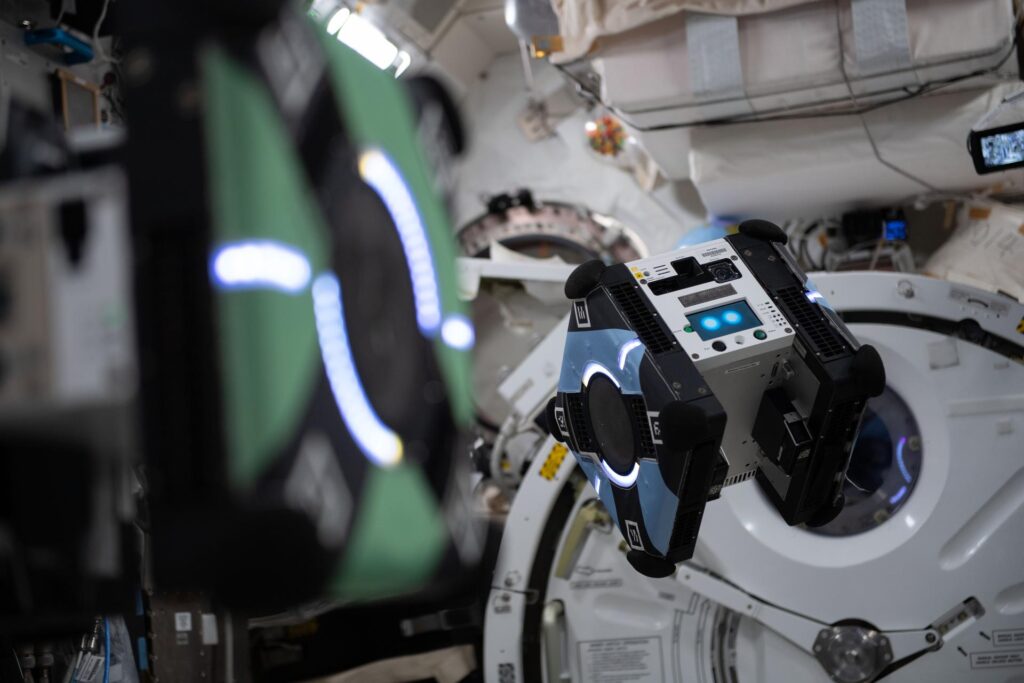
A collaborative effort between NASA and the Gwangju Institute of Science and Technology (GIST) has led to groundbreaking advancements in robotic navigation aboard the International Space Station (ISS). This innovative partnership has introduced a new algorithm that allows NASA’s autonomous robots to operate without constant human oversight, addressing a persistent challenge in microgravity exploration.
Robots like Astrobee, which perform routine tasks aboard the ISS, often struggle with navigation due to the absence of gravity. Unlike terrestrial robots that rely on gravitational cues for orientation, Astrobee frequently loses its bearings, necessitating manual recalibration from astronauts. This interruption not only diverts precious time but also hampers the efficiency of the crew’s scientific missions.
Addressing Navigation Challenges with Digital Twins
Professor Pyojin Kim, an expert in navigation technology, and his team at GIST have developed an algorithm that minimizes the robot’s “absolute rotation error” to just 1.43 degrees. This remarkable improvement allows Astrobee to navigate autonomously over extended periods. The breakthrough stems from the application of “digital twins”—virtual 3D replicas of the ISS environment that enable the robot to calibrate its position accurately.
The challenge of navigating in space is compounded by the chaotic interior of the ISS. Cables, equipment, and personal items can obscure the robot’s camera feeds, making it difficult for standard navigation systems to function effectively. Professor Kim noted that traditional Earth-based algorithms struggled in this cluttered environment. “We thought we could apply established technology,” he explained. “It did not perform reliably in the ISS environments.”
The solution involved creating a digital twin of the ISS, a pristine virtual model stripped of transient clutter. By cross-referencing real-time camera footage with this digital twin, Astrobee can filter out visual distractions and recalibrate its position using geometric features of the station’s structure. This approach allows the robot to maintain a stable orientation, enhancing its operational reliability.
The Broader Implications of Space Navigation Innovation
This technological advancement has broader implications beyond space exploration. Professor Kim anticipates that the navigation techniques developed for Astrobee could also benefit terrestrial applications, particularly in environments where GPS signals are absent, such as indoor spaces. The reliance on visual data to detect structural patterns makes the technology adaptable for various contexts, including urban settings.
Professor Kim’s journey to this significant collaboration began during his doctoral studies, which included an internship at the NASA Ames Research Center. His early experiences with Astrobee shaped his understanding of the similarities between terrestrial drones and space robots, despite their operational differences. “The logic behind mapping an environment and determining location is universal,” he stated.
Reflecting on the culture at NASA, Kim expressed admiration for the agency’s approach to experimentation and failure. “Behind every public triumph lie dozens of quiet failures,” he remarked, emphasizing that NASA’s strength lies in its willingness to embrace setbacks in pursuit of groundbreaking discoveries. This ethos fosters a research environment where practical significance and real-world impact are prioritized over conventional academic metrics.
This collaboration illustrates how partnerships between governmental organizations and academic institutions can yield transformative results in technology. As the commercial space sector continues to evolve, NASA’s foundational work remains crucial in supporting the development of new ventures and innovations.
In a rapidly changing landscape where space exploration holds tangible economic potential, the partnership between NASA and GIST exemplifies how advanced navigation systems can enhance both robotic capabilities and human endeavors in orbit. As Professor Kim concludes, “If you work hard to build your skills, the opportunity will surely follow.”