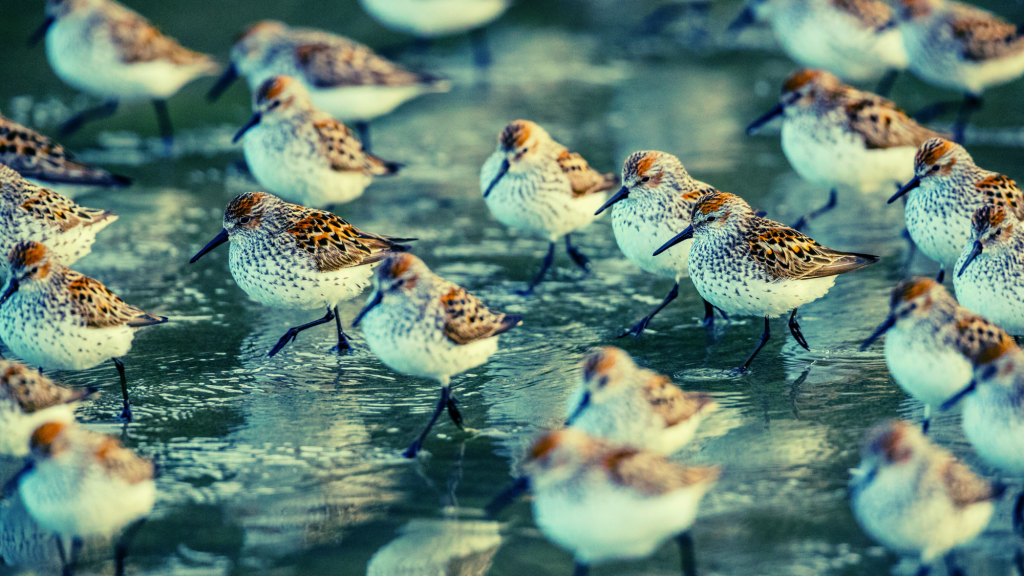
BREAKING: A groundbreaking study reveals that humans possess a remarkable ability, dubbed “remote touch,” allowing us to sense hidden objects without direct contact. This discovery, presented at the IEEE International Conference on Development and Learning, shows humans share this unique skill with shorebirds like sandpipers.
Researchers, led by Elisabetta Versace from Queen Mary University of London, conducted experiments with 12 volunteers who successfully identified a concealed cube buried in sand with a remarkable accuracy rate of 71 percent. This significant finding suggests our sensory perception is more advanced than previously understood.
In the study, participants swept their fingers through granular materials, detecting subtle shifts caused by buried objects. Versace stated, “This discovery expands the ‘receptive field’ of human perception.” The ability is likened to the specialized sensing beaks of shorebirds that detect prey hidden beneath the surface.
In comparison, a robotic tactile sensor was tested alongside human participants. Although the robot could technically sense objects from a greater distance, it produced a disappointing 40 percent accuracy rate, plagued by false positives. This highlights the superiority of human sensory capabilities in certain contexts.
While the practical applications of remote touch may be limited—no one will be locating keys behind drywall anytime soon—the implications for technology are vast. Co-author Zhengqi Chen believes these insights could lead to advancements in assistive technology, enhancing tools that mimic human touch and improving robotic dexterity for delicate tasks.
This study not only highlights a fascinating aspect of human perception but also opens the door for significant developments in engineering and robotics. As researchers continue to explore the intricacies of our senses, the potential for innovation in technology expands.
Stay tuned for more updates on this exciting discovery that bridges the gap between human and animal capabilities!