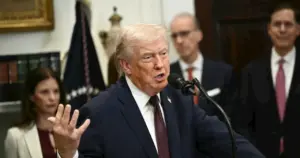
House Democrats are raising concerns regarding the alleged deletion of a photograph featuring former President Donald Trump from a recent Department of Justice (DOJ) release tied to Jeffrey Epstein. The photograph, which shows Trump alongside Epstein, his wife Melania Trump, and Epstein’s associate Ghislaine Maxwell, was reportedly included in a batch of documents released by the DOJ but has since been removed.
The controversy began on December 12, 2025, when the House Oversight Committee disclosed that a photograph identified as file 468 had been deleted from the DOJ’s online records. Committee members expressed their frustration on social media, stating, “This photo has apparently now been removed from the DOJ release. We need transparency for the American public.” The photograph was among at least 16 images that had been released but were later deleted.
In response to inquiries about the removal, the DOJ indicated that the agency encourages the public to report any files it believes should not have been posted. The department stated, “All reasonable efforts have been made to review and redact personal information pertaining to victims and other private individuals.” However, the DOJ acknowledged that due to the large volume of information involved, some sensitive content may have been inadvertently included.
The release of materials related to Epstein followed the passage of the Epstein Files Transparency Act, which mandated the DOJ to make public a significant collection of investigative records associated with the financier. This legal requirement arose amidst increasing political pressure for transparency regarding Epstein’s activities and connections.
Democratic representatives, including Ro Khanna and Thomas Massie, expressed dissatisfaction with the DOJ’s handling of the file release. They criticized the agency for only providing a portion of the requested documents and for the extensive redactions present in the released materials. Khanna noted that a particular document containing 119 pages of Grand Jury testimony was completely redacted, leading to concerns about accountability and the implications for other influential individuals linked to Epstein.
“There’s not a single explanation for why that entire document was redacted,” Khanna stated in a video posted on social media. He emphasized the need for the DOJ to comply with the law’s requirements, particularly regarding the clarification of redactions. The representatives have indicated that they are considering various options to ensure a more complete release of the files.
Massie echoed similar sentiments, criticizing the DOJ’s recent release as failing to meet both the “spirit and letter” of the law signed by Trump just weeks earlier. He highlighted the importance of this transparency effort, stating, “A future DOJ could convict the current AG and others because the Epstein Files Transparency Act is not like a Congressional Subpoena which expires at the end of each Congress.”
As the situation develops, House Democrats remain committed to demanding accountability and transparency from the DOJ regarding the Epstein investigation. They are working alongside survivors and advocates to ensure that all relevant information is made available to the public, fostering a climate of justice and transparency in a matter that has captured significant public interest.
The ongoing scrutiny of the DOJ’s actions underscores the broader implications of the Epstein Files Transparency Act and the importance of maintaining public trust in governmental institutions. The call for clarity surrounding the deleted Trump-Epstein photograph is just one aspect of a much larger conversation about transparency, accountability, and the pursuit of justice for victims of abuse.