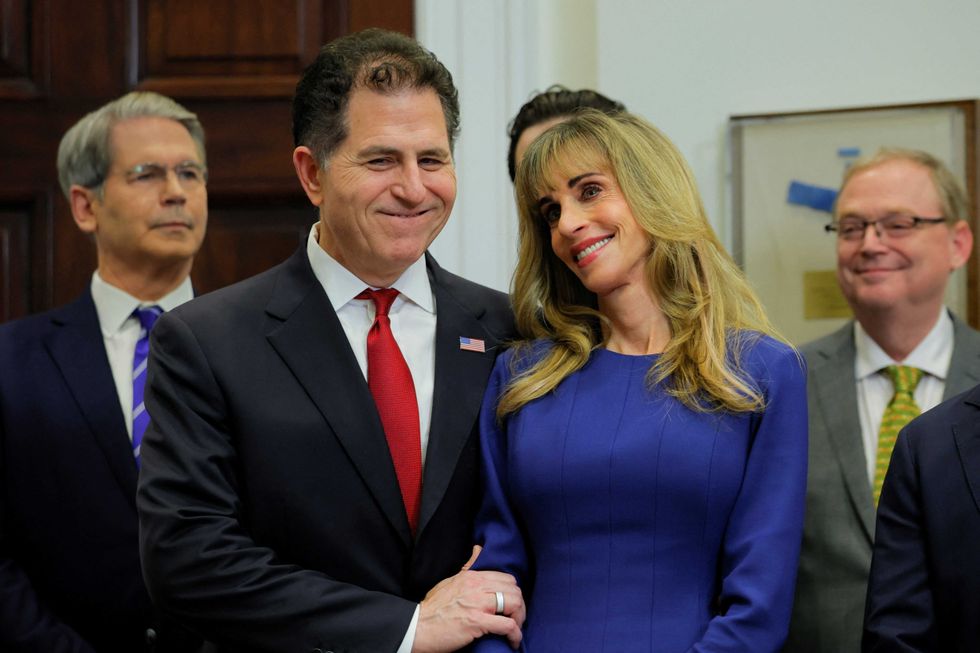
UPDATE: In a surprising announcement on Tuesday, Silicon Valley mogul Michael Dell and his wife, philanthropist Susan Dell, revealed a plan to invest $6.25 billion into individual investment accounts for 25 million American children. This initiative, which aims to extend the controversial “Trump Accounts” introduced in a recent Republican spending bill, has ignited fierce backlash.
Critics, including the National Women’s Law Center (NWLC), question whether this substantial investment will genuinely assist struggling families or simply serve as a tax shelter for the wealthy elite. “While we support direct investments in families, the Trump Accounts being hailed by the White House are a policy solution that doesn’t meet most families’ needs,” stated Amy Matsui, the NWLC’s vice president of income security and child care.
The Dells’ contribution comes months after President Donald Trump enacted a law creating investment accounts for every child born in the U.S. from January 2025 to December 2028, with an initial $1,000 investment from the government. The Dells’ funding aims to include children up to age 10 who were born before this cutoff, potentially impacting around 80% of children born between 2016-2024.
However, critics argue that this initiative may only benefit wealthy families. Vorel from Jezebel pointed out that “a gift of $250, thrown vaguely in the direction of millions of American families by members of our billionaire ruling class,” raises questions about its real-life impact. “What can that money realistically do in terms of providing for a child’s future?”
The success of these investment accounts hinges on the ability of families and employers to contribute meaningfully. With approximately a quarter of U.S. households living paycheck to paycheck, many families may find it challenging to invest the suggested $2,500 per year without it being taxable income.
“Do you know many families in 2025 that would describe themselves as having a spare $5,000 per year to immediately start investing?” Vorel queried, highlighting the financial strain on many households.
As concerns mount, Jonathan Cohn of Progressive Mass emphasized the need for the Dells to pay more in taxes to support public investments in essential services like education and healthcare. “The government should not be funding only what can secure the sympathies of erratic rich people,” Cohn asserted.
The NWLC further criticized the Trump Accounts as emblematic of the administration’s “pronatalism,” promoting childbirth without providing the necessary support for families to thrive. “In the end, this policy mirrors the rest of the law: another giveaway to the richest Americans that leaves everyone else further behind,” Matsui concluded.
This developing story raises critical questions about wealth distribution and the effectiveness of private philanthropy in addressing systemic economic issues. As the Dells’ plan unfolds, the focus will be on whether it can truly benefit the families it aims to serve, or if it will simply reinforce existing inequalities.