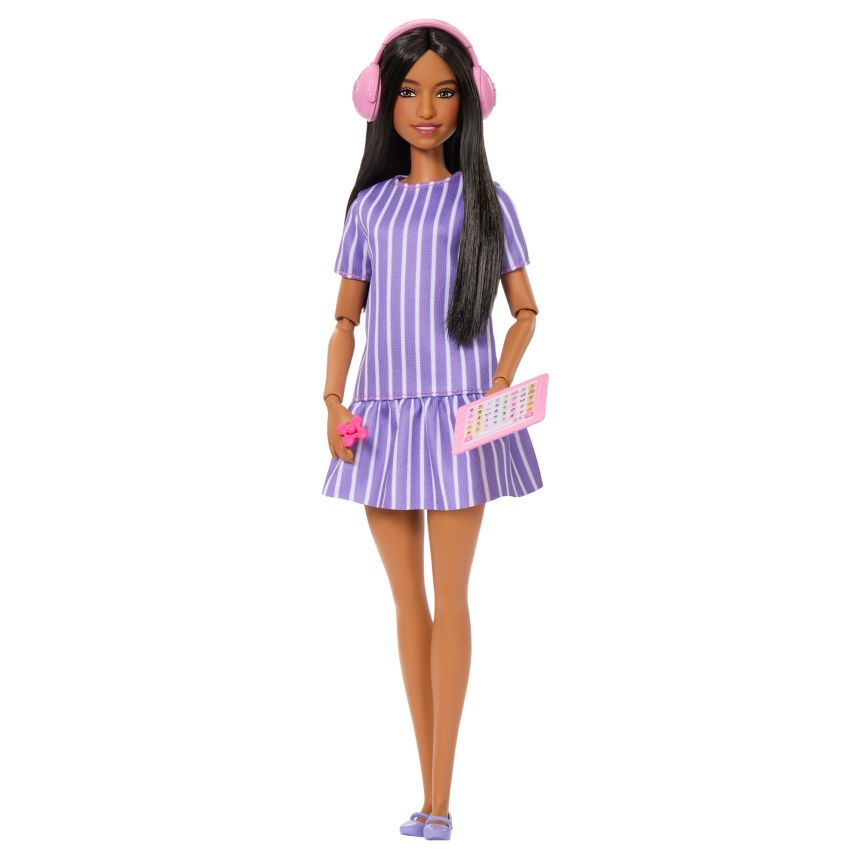
The launch of the first Barbie doll representing autism has garnered significant attention and celebration among autism advocates. Released by Mattel on March 4, 2024, the doll features elements designed to resonate with the experiences of those on the spectrum, including a pink fidget spinner, noise-cancelling headphones, and a tablet symbolizing augmentative and alternative communication (AAC).
Five-year-old Mikko, who is nonverbal and uses an AAC device, was overjoyed to see the doll share characteristics similar to her own. “The moment was almost magical,” said her mother, Precious Hill, a Las Vegas resident. Hill emphasized the importance of representation, stating, “Autism is such an invisible disability at times, and to see that it’s being represented through Barbie—everybody knows who Barbie is—it felt really good.”
The doll’s design includes a gaze that shifts slightly to the side, reflecting a common trait among some individuals with autism who may avoid direct eye contact. Additionally, her fashionable purple pinstripe dress is intentionally loose-fitting and short-sleeved, catering to sensory preferences.
Mattel collaborated with the Autistic Self Advocacy Network to ensure the doll accurately represents the autistic community. According to Colin Killick, executive director of the network, “It is so important for young autistic people to see authentic, joyful representations of themselves.” The initiative aims to highlight the approximately 1 in 31 children diagnosed with autism by age 8 in the United States.
Hill’s family reflects the diverse experiences within the autism spectrum. Alongside Mikko, she has 11-year-old twins, Matthew and Ma’Kenzie. While Ma’Kenzie has not been diagnosed with autism, Matthew, who is autistic, also expressed happiness upon seeing the doll. Hill hopes this launch helps other families feel acknowledged, stating, “I hope that they feel seen too.”
Autism spectrum disorder encompasses a range of neurodevelopmental differences that impact communication, interaction, and sensory experiences. It is often diagnosed before the age of three and persists throughout life. While there is no cure, early support and therapies can significantly improve outcomes. Research indicates that autism is more prevalent in boys, yet many girls remain undiagnosed until adulthood, often after becoming mothers.
Hill herself discovered her diagnosis later in life, only after her daughter was diagnosed at age two. “I didn’t know that I was autistic growing up,” she shared. Her aunt first noticed similarities between Mikko and Hill’s childhood behavior, leading Hill to explore autism further and ultimately receive her diagnosis at age 29.
The significance of the new Barbie doll extends beyond childhood play. Eileen Lamb, senior director of social media and marketing at Autism Speaks, also experienced a late diagnosis. She expressed support for the doll, emphasizing the importance of representation, particularly for girls. “Autism can look different in girls,” she noted, adding that the doll provides an opportunity for discussions that are more approachable and less clinical.
Lamb acknowledged that while the doll highlights essential tools like the fidget spinner and AAC device, it is vital to remember that autism encompasses a broad spectrum. “It’s not possible to represent everyone in one doll,” she explained. Still, she views the release as a significant step forward.
“Toys matter. Representation matters, and it’s really good for children to see themselves in a toy,” Lamb stated, reinforcing the message that being different is nothing to be ashamed of.
As the conversation around autism continues to grow, the introduction of this Barbie doll not only represents a milestone for the brand but also for the millions of families navigating the complexities of autism every day.