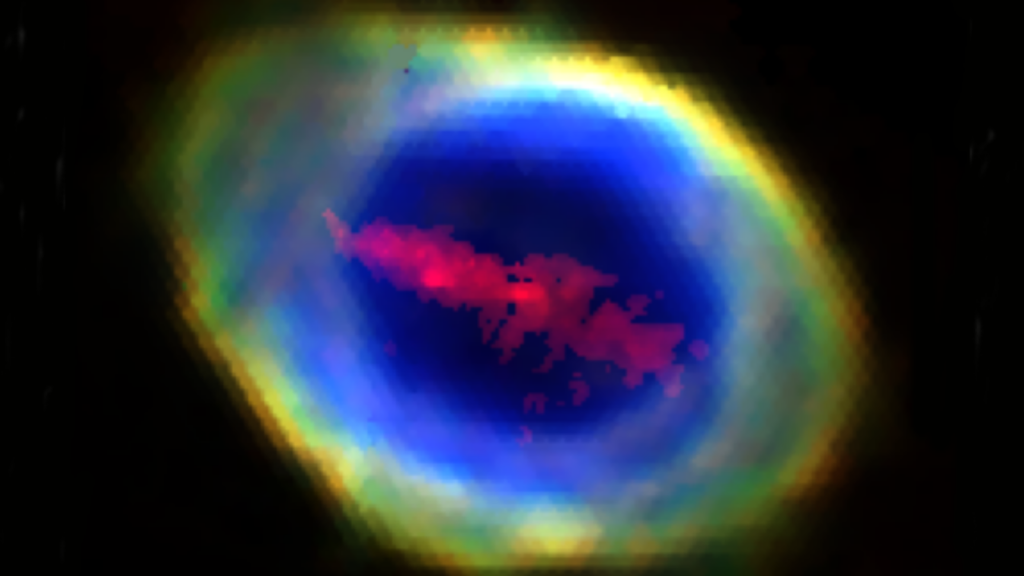
Astronomers studying the well-known Ring Nebula, also designated as Messier 57 (M57), have made a significant discovery: a substantial “bar” of iron atoms hidden within this iconic celestial structure. Located approximately 2,000 light-years from Earth in the constellation Lyra, the Ring Nebula is the remnant of a sun-like star that has shed its outer layers, leaving behind a dense core known as a white dwarf.
The discovery of the iron bar was made by a team using the William Herschel Telescope (WHT) at the Observatorio del Roque de los Muchachos in La Palma, Spain. Utilizing a new instrument called WEAVE (WHT Enhanced Area Velocity Explorer), the researchers achieved a level of detail previously unattainable. The iron structure extends approximately 1,000 times the distance from Pluto to the Sun, with a mass comparable to that of Mars.
Revolutionary Observations with WEAVE
Roger Wesson, the team leader from University College London (UCL), expressed enthusiasm regarding the capabilities of WEAVE. “Even though the Ring Nebula has been studied using many different telescopes and instruments, WEAVE has allowed us to observe it in a new way,” he said. The instrument’s ability to capture a spectrum across all visible wavelengths enabled the team to create detailed images and determine the nebula’s chemical composition.
The discovery of the iron bar was unexpected. Wesson noted that, while scrolling through the processed data, “one thing popped out as clear as anything — this previously unknown ‘bar’ of ionized iron atoms.” This revelation raises intriguing questions about the formation and evolution of the Ring Nebula and similar structures.
Unraveling the Mystery of the Iron Bar
The origins of the iron bar remain unclear, prompting further investigation. One theory suggests that it may be linked to the star’s process of ejecting its outer layers. Alternatively, it might result from a rocky planet being vaporized by the star’s expanding gases. If the latter is true, the Ring Nebula could serve as a precursor of Earth’s future, when the Sun exhausts its fuel and expands into a red giant in approximately 5 billion years.
Janet Drew, an astronomer at UCL and team member, emphasized the importance of further research. “We definitely need to know more — particularly whether any other chemical elements co-exist with the newly detected iron,” she stated. Understanding these elements could provide insight into the formation processes of such astronomical features.
The team plans to conduct follow-up studies with WEAVE to achieve greater resolution and clarity. Scott Trager, WEAVE Project Scientist at the University of Groningen, highlighted the potential for future discoveries. “The discovery of this fascinating, previously unknown structure in a night-sky jewel demonstrates the amazing capabilities of WEAVE,” he said.
As researchers continue to analyze the Ring Nebula, they hope to uncover whether other planetary nebulas contain similar unexpected structures. Wesson noted that it would be surprising if the iron bar in the Ring Nebula were unique, suggesting that further observations might reveal more about the origins of iron in the universe.
This research was published on January 15, 2024, in the journal Monthly Notices of the Royal Astronomical Society, marking a significant advancement in our understanding of nebulae and the processes that shape them.