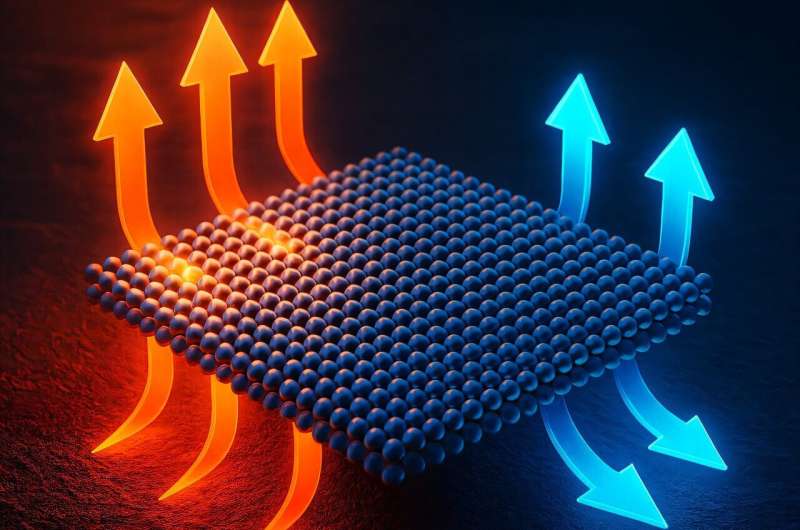
The study of heat flow in ultrathin materials has taken a significant leap forward, thanks to new research led by physicist Alessio Zaccone. Published in the Journal of Applied Physics on December 14, 2025, this groundbreaking work addresses a puzzling phenomenon observed in ultrathin silicon films, revealing insights that could have widespread implications for technology.
Researchers have long known that when materials are reduced to the nanoscale, traditional physical laws can behave unexpectedly. In the case of ultrathin silicon films, studies indicated a surprising dip in thermal conductivity when the thickness reached around one to two nanometers, equivalent to just a few atomic layers. To add to the intrigue, thermal conductivity began to rise again as the films were made even thinner, contradicting established theories.
According to previous models, such as the Boltzmann transport equation, reducing thickness should consistently decrease thermal conductivity due to the limited space for phonons—quantized vibrations of the atomic lattice—to travel. Yet, simulations conducted by a team at Carnegie Mellon University, led by researcher Alan McGaughey, suggested otherwise. This inconsistency sparked an investigation into the underlying mechanisms at play.
In his recent publication, Zaccone revisits the issue of phonon behavior under confinement. Rather than relying solely on traditional quantum well models, he adopted a geometric perspective to understand how phonon momentum states are shaped in reciprocal space. In bulk materials, phonons occupy a spherical region known as the Debye sphere. However, in extremely thin films, phonons with wavelengths exceeding the film thickness cannot exist in the confined direction. Zaccone describes this visualisation as carving out two “holes” within the Debye sphere, creating regions of momentum space that prohibit certain phonon states.
As the film thickness decreases, these forbidden areas expand, distorting the Debye sphere and altering the vibrational landscape. This geometric distortion leads to a higher density of low-frequency phonon states, enhancing the material’s ability to conduct heat. The research indicates that these long-wavelength, low-frequency vibrations dominate the phonon population, ultimately explaining the unexpected thermal conductivity behavior.
Combining this new understanding of phonon density with existing formulas for thermal conductivity yielded a theoretical prediction that closely matched simulation results. The emergence of the conductivity minimum appeared naturally, without requiring arbitrary parameters, showcasing the significance of reciprocal-space geometry in nanoscale materials.
Zaccone argues that this study underscores the importance of re-evaluating assumptions in nanoscale physics. As materials approach their dimensional limits, familiar behaviors can change dramatically, often resulting from simple geometric constraints rather than complex effects.
The implications of this research extend beyond silicon films. Earlier findings have indicated that similar behaviors are even more pronounced in silicon nanowires. As electronics continue to shrink, driven by Moore’s Law, effective thermal management becomes increasingly crucial to prevent overheating. Additionally, the study highlights the importance of understanding heat flow in quantum devices, where precise control of phonon populations is essential for maintaining coherence.
Looking to the future, Zaccone sees exciting opportunities to expand this framework. Potential avenues for exploration include incorporating additional scattering mechanisms and applying the model to various thin films and membranes. The research could also have implications for superconducting devices and quantum information technologies, further enhancing our understanding of how materials behave at the nanoscale.
In summary, Zaccone’s work reveals that even well-established scientific principles can yield surprising results when materials are pushed to their limits. The study not only deepens our understanding of thermal conductivity in nanoscale materials but also opens doors to new technologies and innovations that could emerge from these findings.