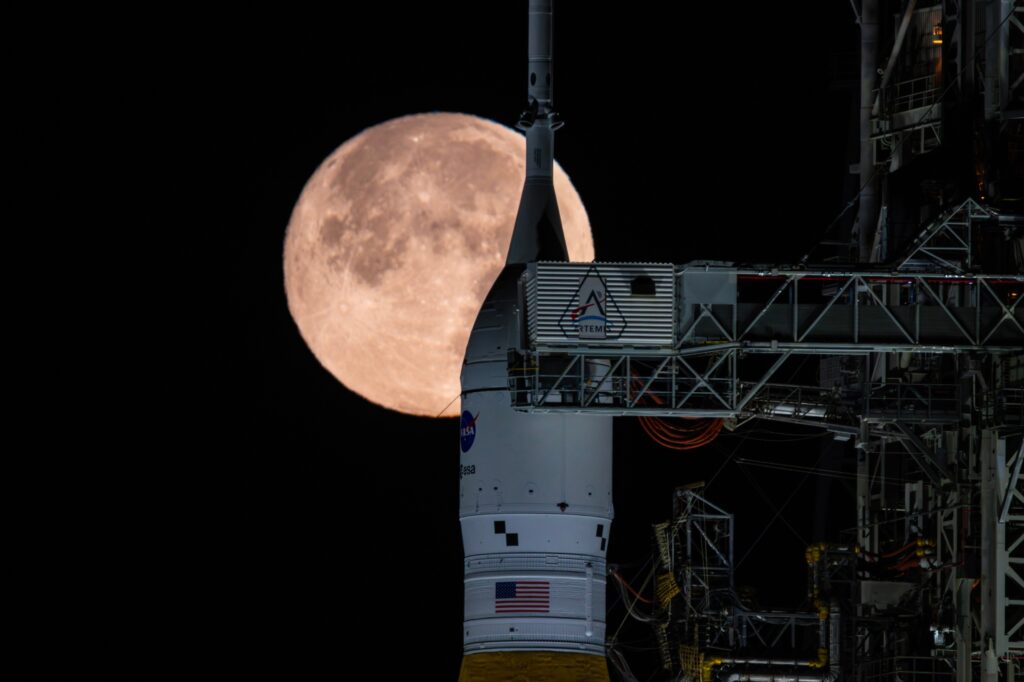
NASA has postponed the launch of its long-awaited moon mission, which was set to carry astronauts to the lunar surface for the first time in over 50 years, due to critical hydrogen fuel leaks encountered during a recent test. The space agency announced on March 5, 2024, that the launch will be delayed until at least March 6, 2024, following issues that arose during a crucial fueling rehearsal at Kennedy Space Center in Cape Canaveral, Florida.
The hydrogen leaks are not new to NASA; they previously delayed the Space Launch System (SLS) rocket’s inaugural flight three years ago. During the latest test, the leaks were first detected early in the loading operation on March 4, and despite efforts to address the problem, they re-emerged later, forcing launch controllers to halt the countdown at the five-minute mark. NASA had originally aimed for a launch as early as this weekend.
Jared Isaacman, NASA’s new administrator, emphasized the importance of safety in a statement shared via X, saying, “We will only launch when we believe we are as ready to undertake this historic mission.” The monthlong delay will allow engineers and the launch team to conduct another fueling test to ensure all systems are functioning correctly before committing the crew of four astronauts—three from the United States and one from Canada—to the lunar fly-around.
During the countdown, NASA attempted to resolve the hydrogen flow issues by warming the area between the rocket and fuel lines, hoping to reseat any loose seals. Unfortunately, these measures did not succeed, nor did adjustments to the hydrogen flow that had previously enabled the SLS rocket to launch without a crew in 2022.
As the launch is postponed, the mission commander, Reid Wiseman, and his crew have been cleared to exit quarantine in Houston. They will re-enter quarantine two weeks before the next scheduled launch attempt. NASA has a limited window of days each month for launching missions to the moon, and the upcoming flight will mark the first time astronauts have ventured to the lunar vicinity since 1972.
The upcoming mission is part of NASA’s Artemis program, which aims to explore new territories on the moon, specifically the south polar region. While the crew will not land on the moon or enter lunar orbit during the nearly ten-day mission, they will test life support systems and other critical capsule functions in preparation for future lunar landings by astronauts.
The Artemis program represents a significant step forward for space exploration, following the Apollo missions that sent 24 astronauts to the moon between 1961 and 1972. The renewed focus on lunar exploration aims to establish a sustainable presence on the moon and pave the way for future missions to Mars and beyond.