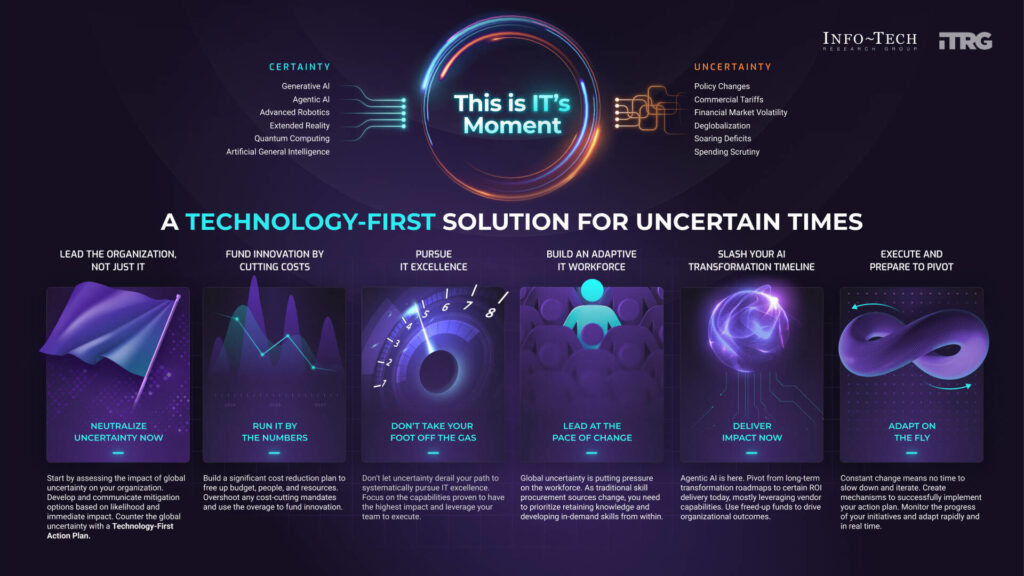
Info-Tech Research Group’s Adapt to Uncertainty With a Technology-First Action Plan for Healthcare blueprint outlines a step-by-step plan for how industry IT leaders can use AI, automation, and FinOps to reduce risk, protect margins, and deliver more equitable and efficient care. (CNW Group/Info-Tech Research Group)
Healthcare organizations are facing increasing challenges due to regulatory changes, rising clinical costs, and workforce shortages. A recent report by the Info-Tech Research Group highlights the need for healthcare IT leaders to adopt proactive, technology-driven strategies to navigate this uncertainty effectively.
Published on December 8, 2025, the report, titled “Adapt to Uncertainty With a Technology-First Action Plan for Healthcare,” outlines a structured approach for IT leaders to leverage artificial intelligence (AI), automation, and financial operations (FinOps). By implementing these technologies, organizations can reduce risks, protect profit margins, and enhance patient care.
According to the research, many healthcare entities remain in a reactive mode, focusing on crisis management instead of strategic planning. Without a technology-first mindset, IT teams often make fragmented decisions that lead to increased operational costs and pressure to maintain clinical quality amidst regulatory scrutiny. The report emphasizes that by integrating AI-driven solutions, healthcare leaders can transform uncertainty into opportunities for growth and efficiency.
Sharon Auma-Ebanyat, principal research director at Info-Tech Research Group, stated, “Healthcare uncertainty is inevitable, but it doesn’t have to be paralyzing. By applying a technology-first mindset, CIOs can shift from firefighting to foresight, transforming today’s pressures into opportunities that strengthen patient outcomes and long-term resilience.”
Four Phases for Building Resilience
The report details a four-phase framework designed to assist healthcare IT leaders in assessing risks, realigning investments, and embedding technology into clinical and operational workflows.
Phase 1 involves assessing uncertainties and opportunities. Executives and IT teams are encouraged to identify external pressures such as policy shifts and cyber risks while mapping technology-driven opportunities that can enhance efficiency and care quality.
In Phase 2, leaders are advised to review budgets, staffing levels, and vendor dependencies. By analyzing IT expenditures and workforce capacity, organizations can eliminate redundancies and refocus investments toward modernization and AI enhancements.
Phase 3 focuses on developing a technology-first action plan. CIOs and digital health leaders should create a prioritized 12-month roadmap that aligns IT initiatives with clinical and operational goals. This plan should emphasize the integration of AI, automation, analytics, and interoperability.
Finally, Phase 4 prepares organizations for execution and adaptation. IT teams must implement governance, change management, and communication structures to ensure accountability and allow for quick adjustments as clinical, regulatory, and operational conditions evolve.
By following this structured approach, healthcare organizations can transition from reactive crisis management to proactive planning. Embracing a technology-first action plan enables CIOs to bolster clinical operations, improve financial resilience, and enhance patient trust, ultimately ensuring that technology investments yield measurable, long-term value across the healthcare ecosystem.
For further insights from Sharon Auma-Ebanyat and access to the complete report, organizations can reach out via email at [email protected]
Info-Tech Research Group is recognized as one of the leading research and advisory firms globally, serving more than 30,000 professionals across IT, HR, and marketing sectors. With nearly three decades of experience, the firm provides unbiased research and expert guidance to help organizations make informed strategic decisions. For more information about their services and research, visit infotech.com.