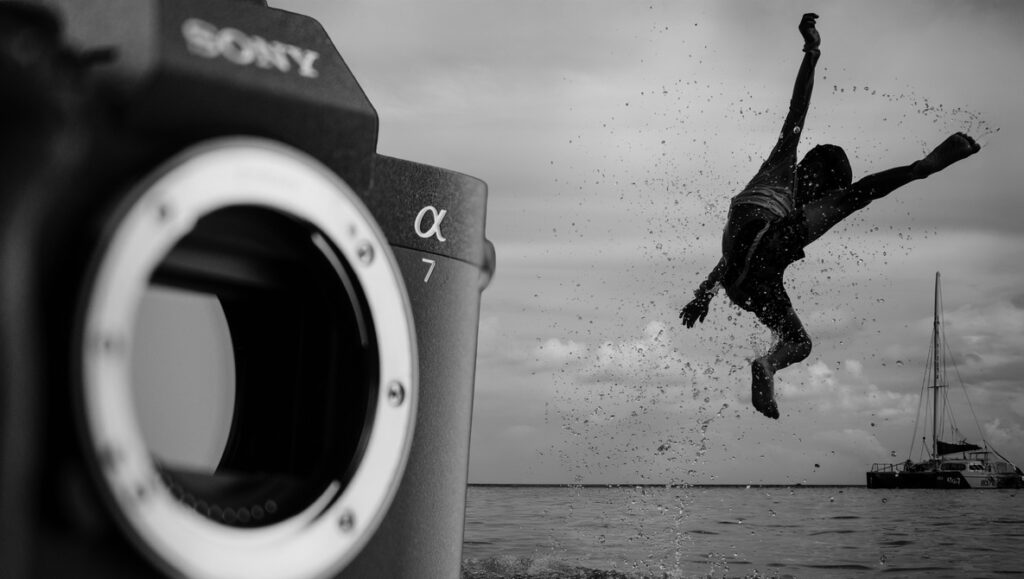
The recent release of the Sony a7 V marks a significant advancement in the world of digital photography, catering to users seeking versatility and high performance. Equipped with a new 33 MP partially stacked sensor, the camera boasts an impressive 16 stops of dynamic range, allowing photographers to capture stunning images in various conditions. During a week-long trip to Aruba, I utilized the a7 V extensively, capturing approximately 6,000 images and testing its capabilities in real-world scenarios.
Among the notable features of the a7 V is its silent shutter, enabled by the newly designed sensor. Traditional sensors often struggle with slow readout speeds, leading to distortions like the “jello effect” when photographing moving subjects. The a7 V’s partially stacked design addresses this issue, providing faster readout speeds than conventional sensors, though not as rapid as the more expensive fully stacked sensors or global shutters.
To evaluate its performance, I photographed my children engaging in various activities. In one instance, my son swung a rake, and the resulting image showed no distortion, despite a 1/250th shutter speed. A quick test of my daughter swinging a plastic sword revealed minor jello-type distortion, but overall, the a7 V performed admirably, capturing fast-paced moments like my nephew running into the ocean with clarity.
The camera excels in electronic shutter mode, achieving 30 frames per second. While this rate can be compared to the Canon R3 at 40 frames per second, the a7 V maintains the advantage of capturing full 14-bit raw files at its max frame rate, a notable feature for serious photographers. The new sensor design also introduces pre-capture and boost modes, enhancing the camera’s usability. Pre-capture allows the camera to buffer images, saving those taken before the shutter is pressed, while the boost button enables instant access to maximum frame rates when needed.
Though the camera’s body design has been well-received, I found some areas for improvement. The absence of the more modern C5 button, featured on the a9 III, is a slight drawback. However, the a7 V does incorporate an impressive flipping and tilting screen, considered one of the best in the market. The introduction of a “shutter type switch” allows users to cycle between electronic and mechanical shutter options more easily, although I would have preferred this functionality to extend to other custom button options.
The a7 V’s processing unit has also been updated, utilizing a single Bionz XR2 processor equipped with a built-in AI unit. This change enhances autofocus accuracy, improves color fidelity, and stabilizes auto white balance. Battery life is rated for 630 images using the electronic viewfinder (EVF) and 750 images with the rear screen. In practical use, I found the battery to last throughout long days of shooting without significant drops in performance.
Despite its strengths, the camera’s design features a flaw related to the screen blackout function meant to conserve battery life. While the screen will turn off after a period of inactivity, the EVF sensor can be inadvertently triggered when the camera is worn on a strap, preventing the screen from shutting down as intended. Addressing this issue would improve functionality in real-world settings.
In addition to its still photography capabilities, the a7 V excels in video, offering 7K oversampled 4K60 with full pixel readout, and can shoot 4K120 in a Super 35 crop or full HD at 240p. While my focus has primarily been on stills, the video quality aligns well with contemporary filmmaking standards.
The camera features a single combo card slot and a second slot limited to SD cards, which may seem restrictive given the advancements in storage technology. However, the addition of a second USB-C port enhances connectivity, allowing for tethered shooting without the need for dummy batteries.
In conclusion, the Sony a7 V stands out as an ideal choice for various photography needs, particularly weddings and portraits. It combines high-resolution capabilities with superior autofocus and video performance, all at a competitive price. While the a9 III may appeal to those requiring ultra-fast readout speeds, the a7 V offers significant advantages in dynamic range and usability, making it a compelling option for both amateur and professional photographers.
Jason Vinson, a wedding and portrait photographer based in Bentonville, Arkansas, has gained recognition as one of the top wedding photographers globally through his company, Vinson Images. He continues to share his expertise and passion for photography, helping others improve their craft.