Enlisted veterans and service members are discovering new pathways to higher education through the Warrior-Scholar Project (WSP), which offers intensive academic boot camps at prestigious universities. One such participant, Air Force veteran Justin Cole, has transformed his perspective on education after serving nearly a decade in the military. His journey reflects the program’s impact on encouraging veterans to pursue academic goals, particularly in science, technology, engineering, and mathematics (STEM).
Cole enlisted immediately after high school, initially undervaluing academic pursuits. This viewpoint changed significantly following his experiences during natural disasters. While stationed in Colorado, he volunteered after the devastating 2013 Black Forest fire. Later, in 2018, he faced two Category 5 typhoons in Okinawa while leading a team focused on satellite communications. “I realized, this climate stuff is really a prerequisite to national security objectives in almost every sense,” Cole said. This insight motivated him to leave the Air Force and pursue engineering courses aimed at addressing climate issues.
After participating in an intensive weeklong STEM boot camp at MIT, Cole decided to transfer to the university in 2024. He is now majoring in climate system science and engineering. The boot camp, part of WSP, simulates a week of undergraduate life, providing rigorous academic exposure across 19 campuses nationwide.
Building Bridges from Military to Academia
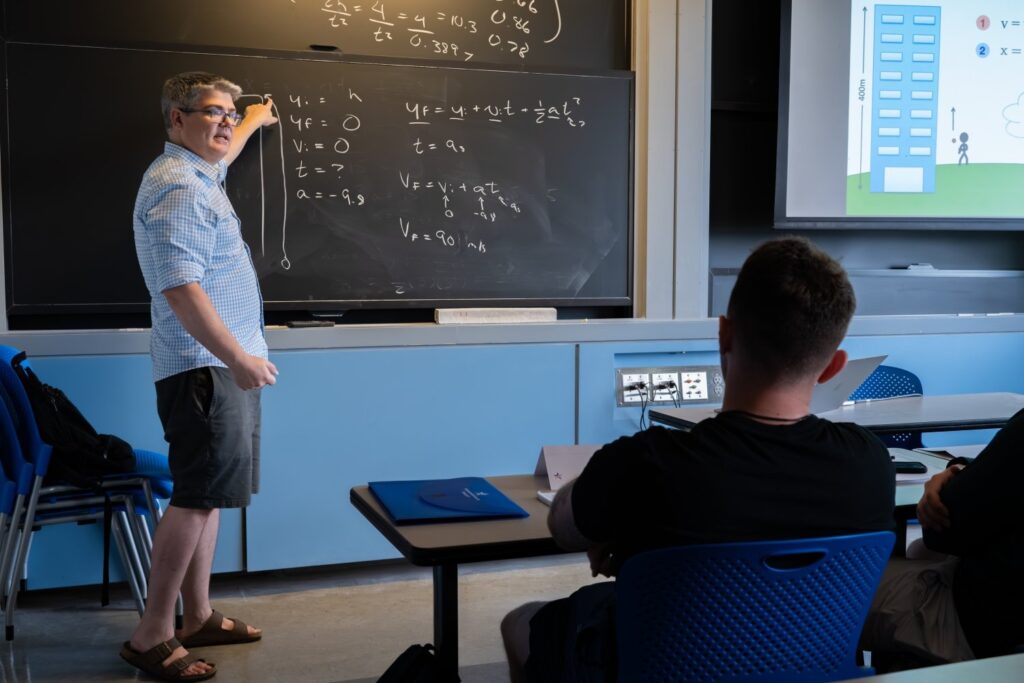
The WSP, founded at Yale University in 2012, aims to facilitate the transition from military service to higher education. MIT joined the initiative in 2017 and has since hosted over 120 scholars, with an impressive 93 percent going on to attend top institutions like Stanford University and Harvard University. The program offers a comprehensive schedule that includes faculty lectures, problem sets, and college success workshops, all designed to prepare scholars for academic challenges.
According to Michael McDonald, an associate professor of physics and co-director of the MIT-WSP program, the learning environment is uniquely engaging. “When I pose a question to my first-year physics class, no one wants to raise their hand,” he noted. “But with this group of veterans, everyone is eager to participate.”
The transformation is palpable throughout the week. Participants often start with self-doubt but leave with newfound confidence in their ability to succeed in academic environments. “They just need to understand that their military experience is incredibly valuable,” McDonald added.
Inspiring Success through Peer Mentorship
A significant aspect of the WSP is the inclusion of alumni who serve as mentors, known as fellows. These veterans provide invaluable support and share their experiences in higher education. Cole recalls how seeing successful veterans inspired him: “Just seeing people existing at these institutions made me realize, this is a thing that is doable.”
Former Marine Aaron Kahler, a participant in the 2024 program, echoed similar sentiments after meeting a veteran PhD student during a tour of MIT’s neuroscience facility. “It was really cool seeing instances of successful veterans doing their thing at MIT,” he said, highlighting the positive impact of mentorship on participants’ aspirations.
As part of their journey, scholars receive a challenge coin designed by McDonald and fellow co-director Nelson Olivier. The coin symbolizes the ethos of the program and serves as a reminder of their potential. One side features Newton’s laws of motion, while the other bears the MIT motto, “mens et manus” (“mind and hand”), along with the scholar’s name. This tangible recognition encourages them to pursue significant contributions in their future endeavors.
The program not only fosters academic skills but also cultivates a sense of community among veterans. Participants like Andrea Henshall, a retired Air Force major and current PhD student, engage actively by mentoring and offering insights into their experiences. “It’s so inspiring to hear students say, ‘I never considered a place like MIT until the boot camp,’” she remarked.
Kahler, now a first-year student at MIT, keeps his challenge coin on display as a source of motivation. “I don’t think I would be here if it weren’t for the Warrior-Scholar Project,” he affirmed.
As the WSP continues to thrive, it exemplifies the potential for veterans to excel in academia, bridging the gap between military service and educational achievement. Through support and mentorship, programs like this pave the way for a new generation of leaders equipped to face the challenges of the future.