A recent study by researcher xoreaxeax has shed light on the relationship between diffraction gratings and Fourier transforms. This work builds on his earlier development of a lens-less optical microscope that determines the structure of samples by analyzing the diffraction patterns produced when a laser beam is directed through them. The findings provide a mathematical foundation for understanding how these patterns can be interpreted as a form of frequency decomposition, an essential characteristic of Fourier transforms.
In his latest explanation, xoreaxeax derived equations for the Fourier transform based on fundamental principles of diffraction. His analysis begins with the assumption that light behaves as a wave, which can be represented by a sinusoidal function. For mathematical convenience, the sine wave formula is transformed into a complex number using exponential notation. According to the Huygens principle, when light emerges from a point source within a sample, it propagates as spherical waves. Consequently, the wave at any given location can be computed as a function of distance.
The principle of superposition plays a crucial role in this process. It states that when two waves intersect at the same point, the resultant amplitude equals the sum of the individual amplitudes. Extending this concept, xoreaxeax applies it to all light sources emanating from the sample, leading to an infinite integral that simplifies to a specific form of the Fourier transform.
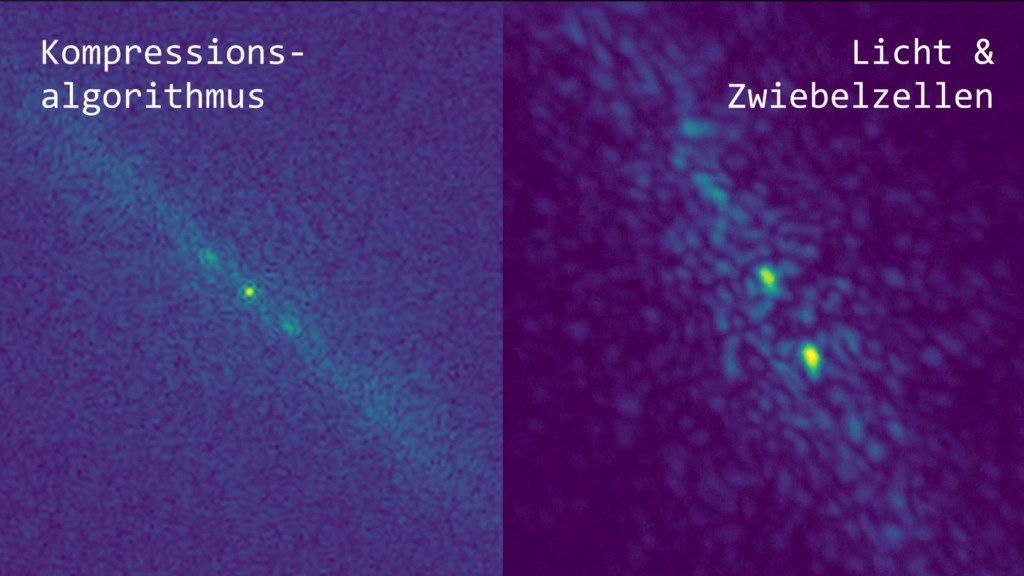
One interesting implication of this relationship is evident in the way micrographs are represented in digital formats. For instance, a JPEG image of onion cells utilizes Fourier transform calculations to compress the image data. This compression method stores the image as a series of sine-wave striped patterns. When these patterns are organized according to their stripe frequency and orientation, and each tile is shaded based on its contribution to the final image, the result resembles a speckle pattern with a bright point at the center. This pattern strikingly mirrors the diffraction pattern observed when a laser is shone through onion cells.
To explore the original experiments that led to these insights, interested readers can refer to xoreaxeax’s initial work on the ptychographical microscope. In addition to this research, scientists are also investigating how physical structures can be employed to compute Fourier transforms, further bridging the gap between optical phenomena and mathematical principles in imaging technology.
This exploration of the connection between diffraction gratings and Fourier transforms not only enhances our understanding of optical microscopy but also has implications for various fields, including digital imaging and data compression. As research continues, the potential applications of these findings could significantly impact how we analyze and interpret complex visual data.