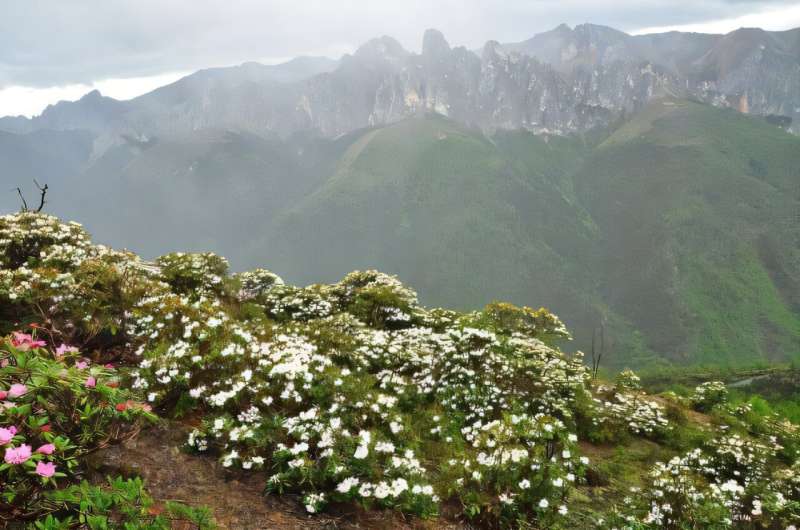
A recent study published in Science Advances has unveiled the significant role of mountain building and climate change in shaping alpine biodiversity over the past 30 million years. Researchers from the Xishuangbanna Tropical Botanical Garden (XTBG) of the Chinese Academy of Sciences, in collaboration with various international institutions, conducted this comprehensive analysis to explain the rich diversity of plant species found in alpine regions.
The research focuses on five major mountain systems in the Northern Hemisphere, revealing that geological processes and climate cooling have been critical drivers of plant diversity. Despite these regions hosting a disproportionately high number of plant species, the mechanisms responsible for this phenomenon have remained largely unexamined until now.
To explore these dynamics, the researchers employed phylogenetic analyses, geological context, and paleoclimate reconstructions. They examined the evolutionary history of 34 groups of flowering plants, encompassing a total of 8,456 species. This method allowed them to track the spread and diversification of these plants across various mountain ranges throughout history.
Key Insights on Plant Evolution
The findings indicate that both mountain uplift and cooler global temperatures are essential for the expansion and diversification of alpine plant groups. According to Xing Yaowu, co-corresponding author of the study, “Our work links plant evolution with Earth’s geological and climate history, showing how ancient mountains and climate changes have shaped alpine life in clear, predictable ways.” The results highlight that mountainous regions created new habitats conducive to the evolution of new plant species, while cooling climates facilitated the connection of previously isolated high-altitude areas.
The study also uncovered notable differences among mountain systems regarding their evolutionary mechanisms. For instance, the Tibeto-Himalayan-Hengduan (THH) region served as a “cradle” for biodiversity, with over half of new species arising from in-situ diversification. Conversely, European and Irano-Turanian alpine floras developed primarily from local mid- to low-elevation lineages adapted to alpine environments. The Tianshan Mountains, on the other hand, mostly “imported” species from the THH region.
Across all regions examined, the research consistently found that active mountain uplift accelerates the formation of new plant species, underscoring the profound influence of geological processes on biodiversity.
Implications for Global Biodiversity
These findings shed light on the complex dynamics that contribute to the diversity of alpine plant communities around the world. As stated by Ding Wenna, first author of the study, “These asynchronous yet predictable assembly dynamics help explain why alpine plant communities differ so much from one region to another today.”
The research indicates that over the last five million years, global cooling intensified connections between cold Arctic and alpine habitats. This transformation has turned the boreal-arctic region into a “biogeographic crossroads” for floristic exchange between Eurasia and North America, further contributing to the rich tapestry of plant life in these mountainous areas.
The study offers a coherent explanation for the exceptionally high biodiversity found in mountain regions, emphasizing the interplay between geological and climatic factors throughout Earth’s history. These insights not only deepen our understanding of plant evolution but also underscore the importance of preserving these vital ecosystems.
For further details, the full research is available in the article titled, “The asynchronous rise of Northern Hemisphere alpine floras reveals general responses of biotic assembly to orogeny and climate change,” published in Science Advances.