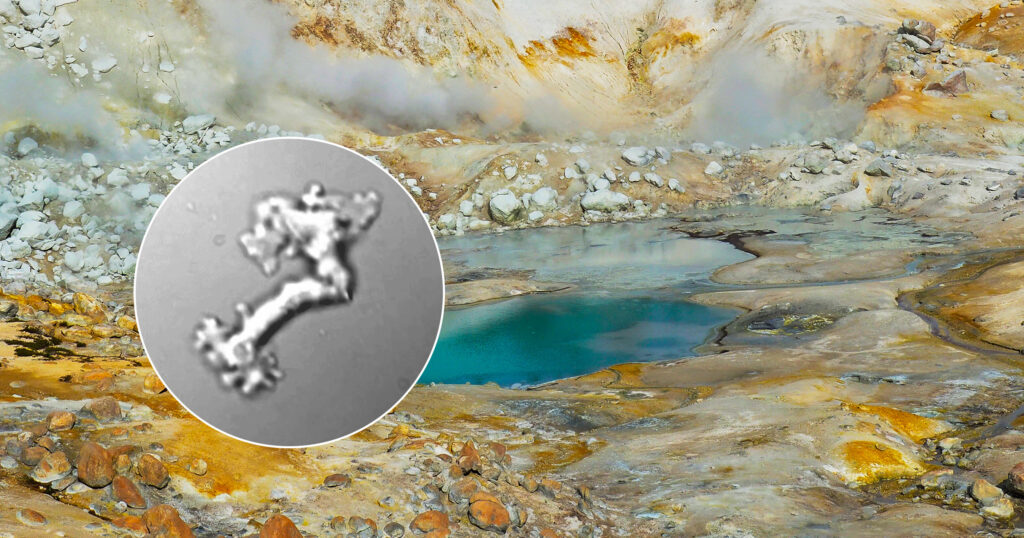
A team of scientists from the United States and Europe has made a groundbreaking discovery in Lassen Volcanic National Park, California. They identified a unique organism, a single-celled “fire amoeba” named Incendiamoeba cascadensis, which can survive and even thrive in extreme temperatures reaching 145.4 degrees Fahrenheit (63 degrees Celsius). This finding sets a new record for the upper temperature limit for all complex organisms on Earth, challenging existing beliefs about the resilience of eukaryotic life.
The park, located in the Cascade Range, features geothermal pools and bubbling mud that can reach temperatures of 464 degrees Fahrenheit (240 degrees Celsius), conditions lethal to most forms of life. The research team, which published its findings in a yet-to-be-peer-reviewed study, suggests that the discovery of this amoeba expands our understanding of life in extreme environments.
Challenging Existing Scientific Beliefs
Traditionally, it was believed that only prokaryotes, such as bacteria, could endure such high temperatures. These organisms can survive between 149 and 221 degrees Fahrenheit (65 to 105 degrees Celsius), with some, like the archaean Methanopyrus kandleri, thriving at temperatures as high as 251.6 degrees Fahrenheit (121 degrees Celsius). The fire amoeba, however, is classified as a eukaryote, which typically includes more complex life forms such as animals and plants.
According to Angela Oliverio, a microbiologist at Syracuse University and co-author of the study, “We need to rethink what’s possible for a eukaryotic cell in a significant way.” The team discovered the fire amoeba in a hot spring stream that had a neutral pH, contrasting with the many acidic pools found in the park.
Initially, the water samples showed no signs of life under the microscope. However, when the researchers added nutrients and heated the samples to 134.6 degrees Fahrenheit (57 degrees Celsius), they observed the previously unknown amoeba moving and replicating. Remarkably, it continued to thrive even as temperatures rose to 145.4 degrees Fahrenheit. At temperatures above this point, the amoeba entered a dormant state, encysting itself to protect against harsh conditions.
Implications for Future Research
The implications of this discovery are significant. The research indicates that eukaryotes may possess mechanisms that allow them to survive extreme environments, which could lead to new insights into cellular integrity and functionality. The team also analyzed the amoeba’s genome, finding a variety of genes associated with protein regulation and environmental sensing.
The presence of the fire amoeba opens up new avenues for further research into undiscovered high-temperature-loving eukaryotes, an area that has been largely dominated by studies of thermophilic prokaryotes. “We looked in one stream,” Oliverio noted. “Maybe we got extremely lucky, and there’s nothing else out there, but we really don’t think that’s the case.”
Additionally, the proteins within the fire amoeba could have important applications in biotechnology, particularly in the development of “thermostable proteins” that could withstand extreme conditions.
This discovery also raises intriguing questions about the potential for life beyond Earth. Researchers speculate that microbial life could exist in extreme environments on other planets, such as the ancient riverbeds and ice caps of Mars.
As the study progresses, the scientific community remains excited about the possibilities this tiny organism presents, both for understanding life on Earth and the potential for discovering life elsewhere in the universe.