Researchers at the University of Oxford have achieved a significant breakthrough in neutrino physics by capturing solar neutrinos transforming carbon atoms into nitrogen. This milestone, reported on December 10, 2025, represents the first time scientists have successfully observed these elusive particles interacting in such a manner, using a state-of-the-art detector located deep underground in Canada.
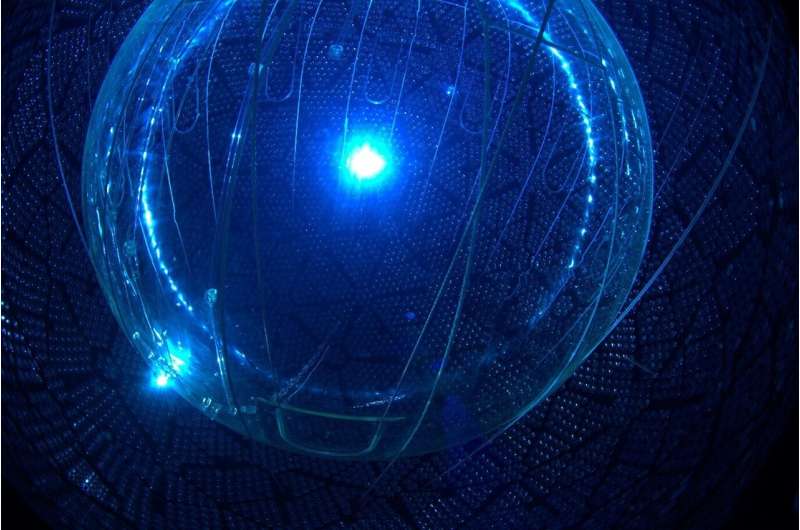
Neutrinos, often referred to as “ghost particles,” are produced during nuclear reactions, including those occurring in the sun’s core. They are notoriously difficult to detect due to their weak interactions with matter—trillions of them pass through our bodies every second without leaving a trace. The research team utilized the SNO+ detector, situated two kilometers beneath the surface in SNOLAB, a facility designed to minimize interference from cosmic rays and background radiation.
Breakthrough Experiment and Detection Method
The researchers aimed to observe interactions where a carbon-13 nucleus is struck by a high-energy neutrino, resulting in a transformation into radioactive nitrogen-13. This nitrogen decays approximately ten minutes after the initial interaction. The team employed a “delayed coincidence” method, which identifies two linked signals: the first flash from a neutrino hitting the carbon-13 nucleus, followed by a second flash from the nitrogen-13 decay. This approach effectively distinguishes genuine neutrino interactions from background noise.
Over a period of 231 days, from May 4, 2022, to June 29, 2023, the analysis recorded 5.6 observed events, aligning closely with the anticipated 4.7 events predicted from neutrino interactions during that time frame.
Impact on Neutrino Research and Future Directions
The discovery is pivotal for advancing our understanding of neutrinos, which play a crucial role in nuclear fusion, stellar processes, and the evolution of the universe. Lead author Gulliver Milton, a Ph.D. student in the Department of Physics at the University of Oxford, expressed that capturing this interaction is a remarkable achievement. “Despite the rarity of the carbon isotope, we were able to observe its interaction with neutrinos, which were born in the sun’s core and traveled vast distances to reach our detector,” he stated.
Co-author Professor Steven Biller noted the significance of solar neutrinos in scientific research, referring to the legacy of the earlier SNO experiment, which contributed to the 2015 Nobel Prize in Physics for resolving the solar neutrino problem. “It is remarkable that our understanding of neutrinos from the sun has advanced so much that we can now use them as a ‘test beam’ to study other kinds of rare atomic reactions,” he said.
The SNO+ project builds on the foundation laid by its predecessor, which demonstrated that neutrinos oscillate between three types—electron, muon, and tau neutrinos—as they travel from the sun to Earth. This ongoing research not only enhances our understanding of neutrinos but also paves the way for new investigations into their properties and interactions.
Dr. Christine Kraus, a staff scientist at SNOLAB, emphasized the importance of this discovery, noting that it represents the lowest energy observation of neutrino interactions on carbon-13 nuclei to date. “To our knowledge, these results provide the first direct cross-section measurement for this specific nuclear reaction,” she explained.
The findings are published in the journal Physical Review Letters, providing a solid foundation for future studies of low-energy neutrino interactions and their implications for our understanding of the universe.