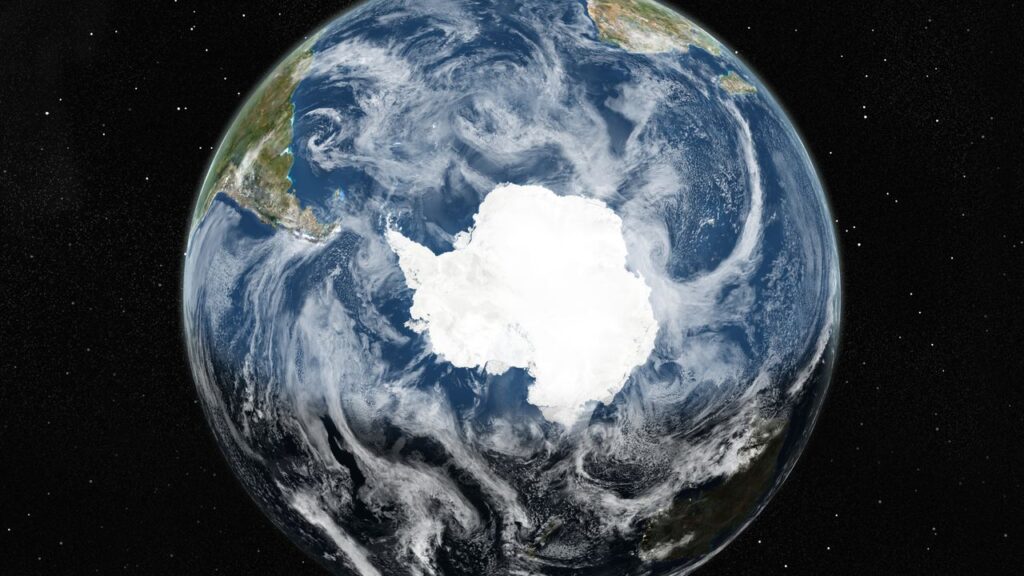
Researchers have made significant strides in mapping Antarctica’s subglacial landscape, revealing details previously hidden beneath the continent’s thick ice. A team led by Helen Ockenden from the University of Edinburgh and the Institut des Geosciences de l’Environnement in France employed a novel modeling technique called Ice Flow Perturbation Analysis (IFPA). This approach utilizes satellite observations of the ice surface, combined with ice thickness data from geophysical surveys, to infer the topography hidden up to 3 miles (4.8 km) below the ice.
The research, published in the journal Science on January 15, 2024, demonstrates the potential of satellite technology to create the most detailed map of Antarctica’s subglacial topography to date. In their findings, the researchers identified previously unknown geological features, including steep-sided channels possibly associated with ancient mountain drainage systems and deep valleys similar to U-shaped glacial valleys found elsewhere on the planet.
Understanding these subglacial features is vital for predicting how Antarctic ice contributes to global sea-level rise. The new IFPA map provides unprecedented insight into the topography beneath the ice, which can help scientists study the movement of ice across the continent. This, in turn, aids in forecasting future changes.
Despite the breakthroughs, the map’s resolution remains at the mesoscale, approximately 1.2 to 18.6 miles (2 to 30 km). Consequently, smaller landforms are not fully captured, indicating the need for further refinement. The research team emphasized that their landscape classification and topographic map serve as essential guides for more focused studies of Antarctica’s subglacial landscape.
Future Research Directions
The team noted the importance of targeted geophysical surveys to enhance the understanding of Antarctica’s hidden topography. Their work sets the stage for future research efforts, particularly in light of the upcoming International Polar Year 2031-2033. Duncan Young from the University of Texas Institute for Geophysics highlighted this period as a crucial opportunity for international collaboration, merging observation and modeling techniques to further explore ice sheet and bedrock properties.
In summary, this research not only pushes the boundaries of Antarctic exploration but also highlights the significance of advanced mapping techniques. As scientists continue to unveil the secrets of the subglacial landscape, the implications for our understanding of climate change and sea-level rise become increasingly critical.