Researchers at the Helmholtz-Zentrum Dresden-Rossendorf (HZDR) have made a significant breakthrough by discovering previously unobserved oscillation states in magnetic vortices, known as Floquet states. This discovery, reported in the journal Science on January 8, 2026, reveals that these states can be generated through subtle magnetic wave excitation rather than the energy-intensive laser pulses required in previous experiments.
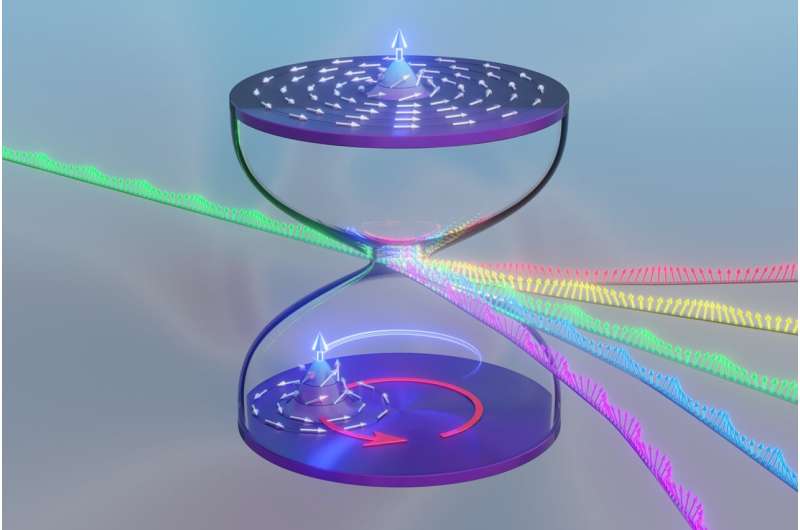
The research team focused on magnetic vortices formed in ultrathin disks of materials like nickel–iron. Within these vortices, the elementary magnetic moments, akin to tiny compass needles, arrange themselves in circular patterns. When these vortices are disturbed, collective wave excitations called magnons can propagate, transmitting information without the need for charge transport. Dr. Helmut Schultheiß, leading the project from the Institute of Ion Beam Physics and Materials Research at HZDR, highlighted the potential of these magnons for next-generation computing technologies.
Initially, the researchers intended to explore the use of smaller magnetic disks—reducing their diameters from several micrometers to just a few hundred nanometers—for neuromorphic computing, a cutting-edge computational framework. While analyzing the data, they observed an unexpected phenomenon: instead of a single resonance line in the spectrum, they detected a series of finely split lines, resembling a frequency comb.
Understanding the Discovery
This unexpected finding prompted the team to investigate further. Initially, they suspected measurement artifacts or interference. However, upon repeating their experiments, the effect consistently appeared, confirming that they were observing a new physical phenomenon. The underlying principle relates to the work of French mathematician Gaston Floquet, who demonstrated in the late 19th century that systems experiencing periodic driving can develop new states.
Traditionally, generating Floquet states required significant energy input from strong laser pulses. The HZDR team found that in magnetic vortices, these states could self-emerge if magnons are excited strongly enough. This interaction leads to a minute circular motion of the vortex core, which then modulates the magnetic state rhythmically. Instead of a single resonance, the researchers observed multiple regularly spaced lines, akin to harmonic overtones produced by a pure tone.
Implications for Future Technologies
The efficiency of this process is particularly noteworthy. It can be initiated with very low energy inputs, requiring only microwatt levels—far less than the power consumed by a smartphone in standby mode. This efficiency opens up exciting possibilities for synchronizing disparate systems, potentially linking ultrafast terahertz phenomena with conventional electronics or quantum components.
Dr. Schultheiß described this capability as a “universal adapter,” drawing parallels to how USB adapters enable different devices to connect. By bridging frequencies that would typically be incompatible, Floquet magnons could facilitate the integration of electronics, spintronics, and quantum information technology.
Looking ahead, the research team plans to explore whether the principles discovered can be applied to other magnetic structures. They believe this work not only addresses fundamental questions in magnetism but could also lead to innovative computing architectures by enhancing the interconnection of magnonic signals, electronic circuits, and quantum systems.
The findings from this research hold promise for a new era of technology, potentially transforming how various physical systems interact and communicate. As Dr. Schultheiß noted, the discovery is a significant step forward, paving the way for advancements in both fundamental physics and practical applications in computing and beyond.