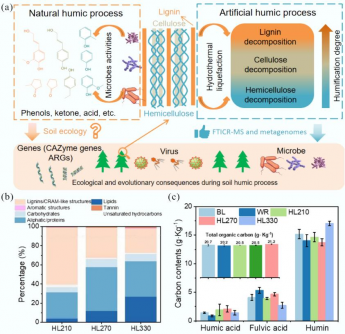
Research conducted by a team from the Chinese Academy of Sciences has revealed significant insights into the role of humic substances in soil ecosystems. By simulating the natural humification process through controlled thermal treatments of crop residues, the study highlighted how humic substances formed at elevated temperatures can enhance microbial metabolism while also promoting the accumulation of antibiotic resistance genes (ARGs).
Every year, billions of tons of lignocellulosic biomass, primarily from crop residues, are introduced into soils globally. This natural process of decomposition and humification is vital for maintaining soil fertility, carbon sequestration, and microbial balance. However, the molecular composition of organic matter influences not only how microbes access energy but also how viral interactions occur within these ecosystems.
Previous research has indicated that organic inputs can affect microbial stress responses and antibiotic resistance. Yet, the specific impact of lignocellulose-derived humic substances, especially phenolic compounds released from lignin, had not been thoroughly understood. The new findings, published on December 5, 2025, in the journal Agricultural Ecology and Environment, provide crucial information on this topic.
Key Findings on Soil Microbial Metabolism
To explore the regulatory effects of humification-derived organic matter on microbial metabolism and resistance traits, researchers synthesized artificial humic substances from rice straw using hydrothermal liquefaction at temperatures of 210, 270, and 330 °C. These temperatures correspond to the progressive breakdown of hemicellulose, cellulose, and lignin. The resulting humic substances, labeled HL210, HL270, and HL330, were chemically analyzed using advanced techniques, including excitation–emission matrix fluorescence spectroscopy and gas chromatography-mass spectrometry.
When these substances were introduced to paddy soils at equal concentrations of total organic carbon, a significant alteration in microbial functional responses was observed. Metagenomic sequencing quantified changes in carbohydrate-active enzymes (CAZymes), viral auxiliary metabolic genes (AMGs), and ARGs. The study found that as hydrothermal temperature increased, the transformation of lignin-derived structures into more accessible carbon sources also rose.
The results indicated that the abundance of glycoside hydrolases, glycosyl transferases, and carbohydrate-binding modules within CAZymes increased significantly, suggesting enhanced microbial degradation of various carbohydrates. In HL330-treated soils, the abundance of ARGs increased by up to 4.6-fold, particularly among taxa such as Proteobacteria and Firmicutes.
Implications for Soil Management Practices
The research underscores a critical trade-off between the benefits of soil carbon sequestration and the potential risks associated with antibiotic resistance. While humification promotes soil carbon storage and fertility, it may also inadvertently facilitate the spread of resistance traits among microbial communities in agricultural soils.
Understanding this balance is essential for developing sustainable residue-return practices and effective soil management strategies. The findings call for a reevaluation of how crop residues are managed, emphasizing the need for practices that maximize ecological benefits while minimizing risks related to antibiotic resistance.
As the agricultural sector increasingly focuses on sustainability, these insights will be vital for policymakers and practitioners aiming to enhance soil health while addressing emerging challenges. The study, supported by the National Natural Science Foundation of China, provides a foundation for future research into the complex interactions between agricultural practices and soil ecosystems.
For more information, the full study can be accessed via the DOI: 10.48130/aee-0025-0010.