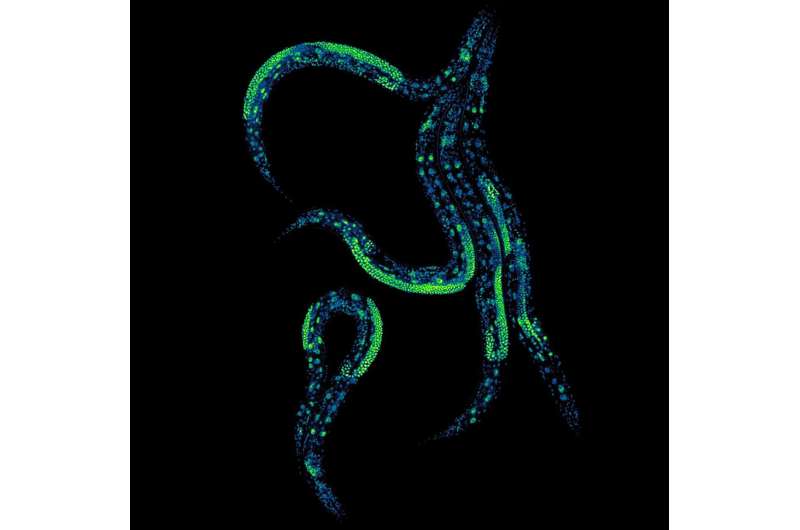
Scientists have developed a groundbreaking method to control protein levels in living animals, marking a significant advancement in biological research. Researchers at the Center for Genomic Regulation in Barcelona and the University of Cambridge successfully demonstrated this technique using the nematode worm Caenorhabditis elegans. Published on December 12, 2025, in the journal Nature Communications, the study allows for precise modulation of protein concentrations throughout an animal’s life, providing new insights into aging and disease mechanisms.
Transformative Implications for Biology
This innovative approach enables scientists to explore complex biological questions that have previously remained unanswered. It facilitates the understanding of how varying protein levels can affect health and contributes to the investigation of systemic processes like aging, which involve intricate interactions between different organs. According to Dr. Nicholas Stroustrup, a researcher at the Center for Genomic Regulation and senior author of the study, “No protein acts alone. Our new approach lets us study how multiple proteins in different tissues cooperate to control how the body functions and ages.”
Traditional experimental methods have limitations in isolating the effects of proteins across various tissues, often relying on binary on/off switches. The new technique offers a more refined control, allowing researchers to fine-tune protein levels in specific tissues. This capability is crucial for studying how minute changes in protein concentration can influence overall health and aging.
Understanding the New Method
The technique is based on an adaptation of a system originally derived from plant biology. Plants utilize a hormone called auxin to regulate growth, and researchers have previously developed the auxin-inducible degron (AID) system to manipulate protein levels in laboratory settings. By enhancing this technology, the research team created a “dual-channel” AID system, which enables simultaneous control of proteins in various tissues.
In their experiments, the team engineered different versions of the TIR1 enzyme, which recognizes a degron tag attached to target proteins. When the nematodes are fed food containing auxin, TIR1 activates, enabling selective removal of the tagged protein. This system allows scientists to adjust protein levels without affecting the organism’s normal behavior, such as eating and moving.
The breakthrough also addresses a common limitation of AID systems, which often fail to function in reproductive tissues. By modifying their approach, the researchers successfully extended the method’s applicability to these critical areas, allowing for comprehensive protein control across the entire organism.
“This was quite an engineering challenge. We had to test various combinations of synthetic switches to find the perfect pair that didn’t interfere with one another,” explains Dr. Jeremy Vicencio, a postdoctoral researcher at the Center for Genomic Regulation and co-author of the study. “Now that we’ve cracked it, we can control two separate proteins simultaneously with incredible precision.”
The implications of this research are profound, potentially paving the way for new experiments that could transform our understanding of biological processes. As the scientific community continues to explore the intricacies of life at the molecular level, this innovative protein control technique could unlock new avenues for research in health, aging, and disease prevention.