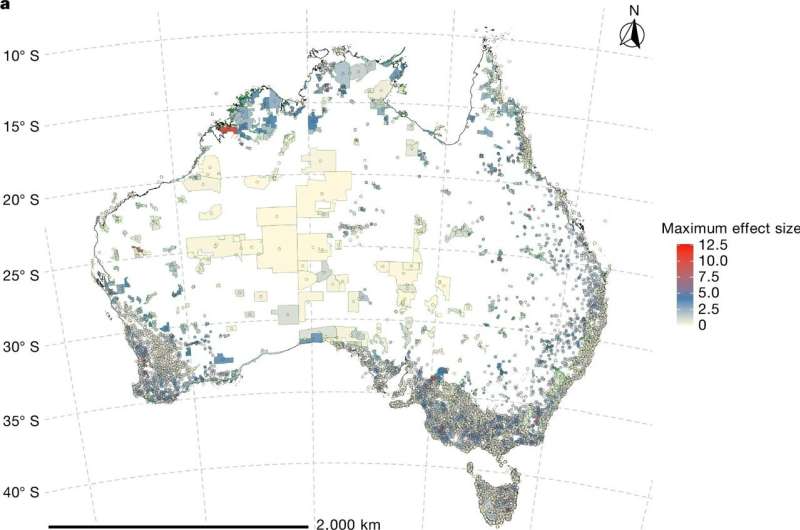
Research published in the journal Nature highlights the significant role that spillover effects from protected areas, such as national parks and wildlife reserves, can play in enhancing biodiversity beyond their boundaries. Conducted by Professor Graeme Cumming from the University of Western Australia, this study underscores how these spillovers can provide valuable ecosystem services, including climate mitigation, water retention, and erosion control.
Key Findings on Vegetation Spillovers
The study assessed a total of 3,063 protected areas across Australia, revealing that approximately 71% (2,189) of these areas exhibited vegetation spillover effects within a 5-kilometre radius of their boundaries. This percentage gradually decreased with increasing distance from the protected areas. Notably, in Western Australia, locations such as Monadnocks Conservation Park, Lane Poole Reserve, and Beelu National Park demonstrated some of the most pronounced spillover effects.
“Spillovers from protected areas multiply the benefits of area-based conservation by increasing the range of places endangered and beneficial species can inhabit,” said Professor Cumming. He emphasized that this understanding can aid in making informed decisions to combat ongoing biodiversity loss and ecosystem degradation.
Factors Affecting Spillover Effects
The study identified several factors influencing plant growth at the boundaries of protected areas. Local environmental variations, including differences in rainfall and topography, as well as broader geographical gradients, play a significant role. After adjusting for these variables, it was determined that the size of the vegetation spillover effect is also reliant on the management practices within the protected areas.
Furthermore, the research indicated that vegetation spillovers could be predicted at larger scales based on easily measurable environmental factors, location, and management type. This predictive capability could enhance conservation strategies, making it easier to assess the benefits of protected areas.
Professor Cumming noted, “Biodiversity conservation efforts and value assessments often focus solely on what exists within protected areas. Increased attention to spillover effects is likely to reveal that these areas hold greater value to society than current estimates suggest.”
This research provides critical insights for policymakers at both state and federal levels, potentially guiding the development of strategies that facilitate the dispersal of biodiversity and its associated benefits from protected areas.
For more information, refer to the original study published in Nature by Professor Graeme Cumming, titled “Protected area management has significant spillover effects on vegetation,” DOI: 10.1038/s41586-025-09837-8.