A new theory presented by researcher Muhammad Ghulam Khuwajah Khan at the Indian Institute of Technology in Jodhpur suggests that outer space may behave like a viscous fluid, challenging current cosmological models. In a paper that has yet to undergo peer review, Khan’s hypothesis addresses longstanding questions regarding the composition of space and the roles of dark matter and dark energy.
Traditionally, astronomers rely on the Lambda Cold Dark Matter Model, often referred to as the ΛCDM model, to explain the universe’s formation and expansion. This model relies on the cosmological constant, represented by the Greek letter Lambda (Λ), which is thought to be a stable energy density throughout spacetime. However, recent observations from the The Dark Energy Spectroscopic Instrument (DESI) survey in Arizona and the Dark Energy Survey in Chile have indicated inconsistencies with this long-standing model.
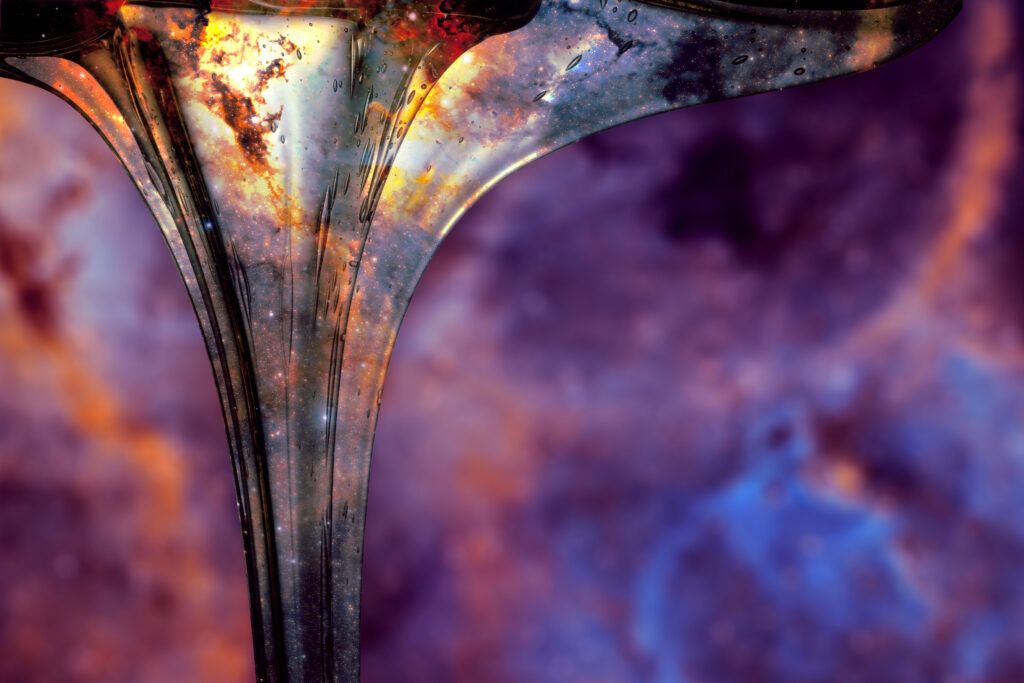
According to Khan, the discrepancies observed suggest that dark energy, previously considered constant, may have weakened as the universe expands. His theory posits that space should be treated as a stretchy, viscous fluid capable of hosting what he terms “spatial phonons.” These phonons, akin to vibrations emitted by atoms, would create waves of tension within space itself.
Khan’s model implies that while dark energy pushes the universe outward, these phonons exert a subtle counterforce, leading to a non-uniform expansion. This perspective aims to reconcile the differences noted by astronomers between observational data and the predictions of the ΛCDM model.
The implications of this theory could be significant. It retains the essence of dark energy as a driving force behind cosmic expansion while introducing a novel explanation for observed anomalies. As Khan notes, further data from ongoing dark energy surveys will be crucial in determining the validity of his proposal.
While the idea is provocative, it remains to be seen whether it can withstand rigorous scientific scrutiny. The forthcoming months will be critical as researchers evaluate this theory against accumulating observational data. The scientific community will be closely monitoring developments in this area, which could reshape our understanding of the universe.
In the quest to decode the mysteries of space, Khan’s theory adds another layer to the ongoing exploration of the cosmos. As scientists work to unravel the complexities of dark matter and dark energy, this new perspective invites a deeper examination of how we perceive the fabric of the universe.