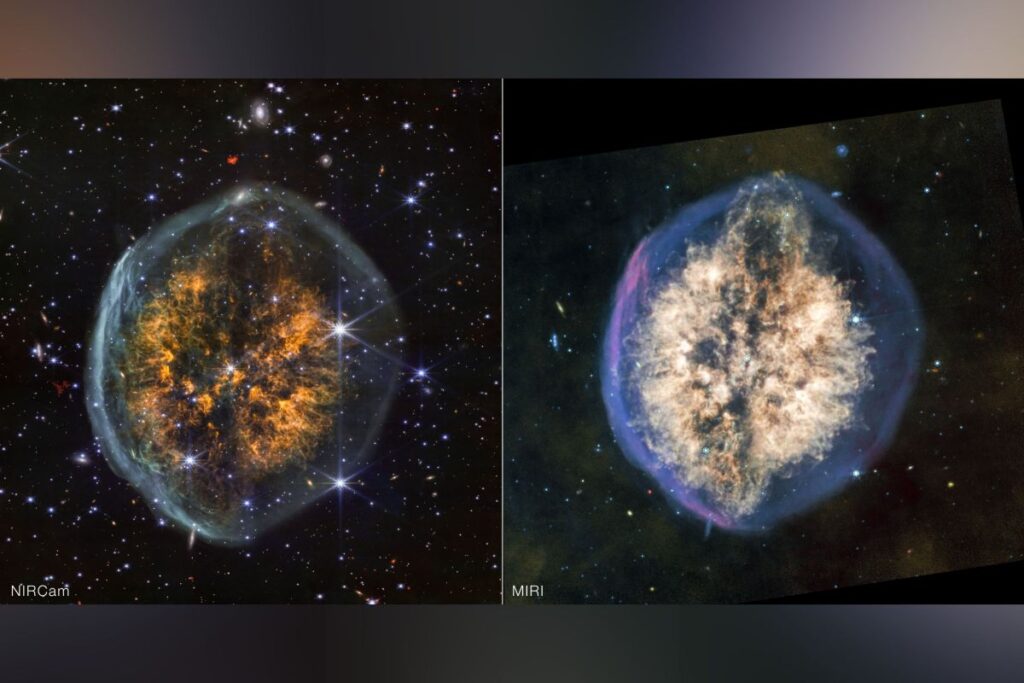
NASA has unveiled new images of a little-known nebula, designated PMR 1, captured by the James Webb Space Telescope. The striking visuals depict a celestial formation that bears an intriguing resemblance to a brain encased in a transparent skull. This discovery offers valuable insights into the life cycle of stars as they near the end of their existence.
Insights into Star Evolution
The images, taken using both near-infrared light with the NIRCam and mid-infrared with MIRI instruments, illustrate a significant stage in the evolution of a dying star. PMR 1, informally known as the “Exposed Cranium” nebula, features split hemispheres and a dark central lane. According to NASA, these characteristics may provide clues about how stars shed their outer layers during their final stages.
The nebula showcases an outer shell composed primarily of hydrogen, which was ejected first, while a more structured inner cloud consists of various gases. The MIRI observations highlight apparent ejections at the top of the nebula, suggesting a connection to an outburst or twin jets originating from the central star. Notably, the NIRCam images reveal additional stars and background galaxies, enhancing our understanding of this cosmic phenomenon.
Located in the constellation Vela, PMR 1 is situated approximately 5,000 light-years from Earth. The composite image produced by Webb spans around 3.2 light-years, showcasing the nebula’s vastness and complexity. NASA has not yet determined the mass of the central star, leaving open the possibility of its future as either a dense white dwarf, similar to our sun, or an explosive supernova if it possesses sufficient mass.
Previous Discoveries and Upcoming Events
The planetary nebula was first identified in infrared light over a decade ago by NASA’s retired Spitzer Space Telescope. The recent images from Webb have reignited interest in PMR 1, as NASA shared their observations on social media. The agency posted on X, “A brain-new image from Webb! What looks like a brain is actually a dying star blowing off a shell of gas, and within that shell, a cloud of various gases.”
In addition to this exciting discovery, NASA has announced a total lunar eclipse scheduled for March 3, 2024. The event will be visible across the Pacific, with specific viewing times varying for regions such as eastern Asia, Australia, North and Central America, and far western South America.
The eclipse will begin with a penumbral phase at 12:44 a.m. PST (3:44 a.m. EST / 08:44 UTC), followed by a partial eclipse at 1:50 a.m. PST (4:50 a.m. EST / 09:50 UTC). Totality, when the entire moon is covered by Earth’s shadow, will commence at 3:04 a.m. PST (6:04 a.m. EST / 11:04 UTC), transforming the lunar surface into a coppery red hue. The totality phase will conclude at 4:03 a.m. PST (7:03 a.m. EST / 12:03 UTC), and the partial eclipse will end at 5:17 a.m. PST (8:17 a.m. EST / 13:17 UTC), wrapping up with the penumbral phase finishing at 6:23 a.m. PST (9:23 a.m. EST / 14:23 UTC).
These celestial events not only captivate the imagination but also provide critical opportunities for scientific research and public engagement in astronomy.