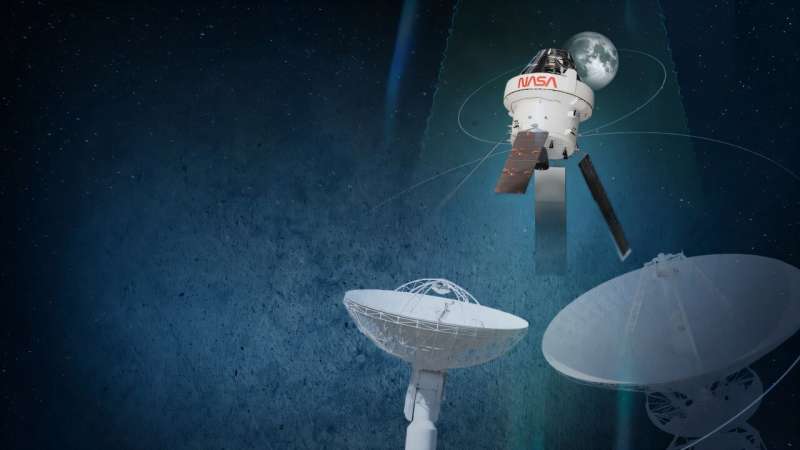
NASA’s upcoming Artemis II mission is set to transport four astronauts around the moon, marking a significant step toward sending humans to Mars. This ambitious mission requires reliable communication systems to ensure real-time data exchange between the spacecraft and mission control on Earth. Throughout the Artemis II journey, astronaut voices, images, video, and critical mission data will traverse thousands of miles, supported by NASA’s advanced communications infrastructure.
NASA’s Communication Networks
To facilitate successful operations, the Artemis missions rely on the Near Space Network and the Deep Space Network, overseen by NASA’s Space Communications and Navigation (SCaN) Program office. These networks utilize global infrastructure and relay satellites to maintain seamless communications and tracking as the Orion spacecraft launches, orbits Earth, travels to the moon, and returns home.
Ken Bowersox, associate administrator for NASA’s Space Operations Mission Directorate, emphasized the importance of these robust space communications. “They’re the essential link that unites the crew and the exploration team on Earth to ensure safety and mission success,” he stated. Bowersox, who has experience aboard the International Space Station, highlighted that from real-time conversations with mission controllers to data that drives critical decisions, effective communication keeps astronauts connected to mission managers and their loved ones.
NASA’s Mission Control Center at the Johnson Space Center in Houston will monitor the Space Launch System rocket, the Interim Cryogenic Propulsion Stage, and the Orion spacecraft through coordinated handoffs between various network assets. The Near Space Network, managed by NASA’s Goddard Space Flight Center in Greenbelt, Maryland, provides communications and navigation services during multiple phases of the Artemis II mission.
After Orion’s translunar injection burn, which sets the spacecraft on its planned orbit around the moon, primary communications will transition to the Deep Space Network, managed by the Jet Propulsion Laboratory in Southern California. This network features an international array of large radio antennas located in California, Spain, and Australia, ensuring a near-continuous connection with Orion and its crew.
Innovative Technologies and Future Goals
Kevin Coggins, deputy associate administrator for the SCaN Program, underscored that “reliable communications are the lifeline of human spaceflight.” He noted that the networks play a crucial role in enabling missions like Artemis II while paving the way for future explorations. The collaboration with commercial partners further enhances NASA’s capabilities and resilience in space communications.
In addition to traditional radio support, the Orion spacecraft will feature the Orion Artemis II Optical Communications System, a laser communications terminal. This system is set to transmit scientific and crew data over laser links, demonstrating the potential for higher data transmission rates. Recent tests have shown that laser communications can transmit over 100 times more data than conventional radio networks, even at vast distances from Earth.
Although laser communications will not be utilized in Artemis III, the Orion Artemis II Optical Communications System is a pivotal step towards future advancements in lunar and deep space communications. While Orion will experience a planned communications blackout lasting approximately 41 minutes as it passes behind the moon, similar occurrences were recorded during the Apollo missions. Upon reemerging, the Deep Space Network will quickly reacquire Orion’s signal, restoring communication with mission control.
NASA is also working on its Lunar Communications Relay and Navigation Systems project in collaboration with industry partners to eliminate blackouts and enhance navigation precision. This initiative aims to position relay satellites around the moon, ensuring persistent, high-bandwidth communications and navigation services for astronauts and equipment on the lunar surface.
In 2024, NASA selected Intuitive Machines to develop the first set of lunar relay satellites for demonstration during the Artemis III mission. This network will significantly improve communication capabilities for future lunar missions.
From the moment of liftoff to splashdown, NASA’s evolving communication networks will remain the crucial link for the Artemis II crew, ensuring that humanity’s return to the moon is connected at every stage of the journey. With these advancements, NASA continues to pave the way for more ambitious explorations beyond Earth.