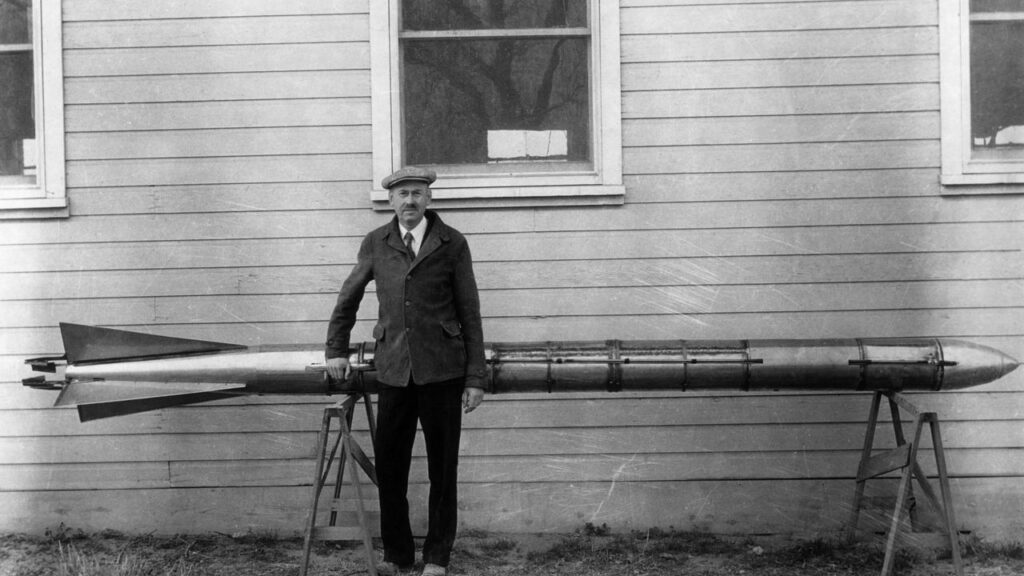
On March 16, 2026, NASA will commemorate the centennial of the first successful liquid-fueled rocket launch, an innovation credited to Robert Goddard. This momentous event, which took place in a cabbage field in Auburn, Massachusetts, marked the beginning of modern rocketry. Goddard’s rocket soared just 40 feet into the air, yet it laid the groundwork for technologies that would eventually enable human exploration beyond Earth.
Goddard’s pioneering work evolved rapidly. He developed various advanced systems that transformed rocketry, becoming the foundation for nearly every significant launch vehicle to follow. His innovations, such as turbopumps and gimbaling engines, are still vital components of today’s rockets. As NASA prepares to launch the first crewed mission of its Artemis program, the impact of Goddard’s contributions is clearer than ever.
Artemis 2: A New Chapter in Lunar Exploration
The upcoming mission, known as Artemis 2, is set to carry astronauts on a 10-day journey around the moon. Scheduled for launch no earlier than April 1, 2026, the mission will utilize NASA’s Space Launch System (SLS), a rocket that stands at a towering 322 feet (98 meters) tall. This vehicle is approximately 30 times larger than Goddard’s original rocket.
At the helm of the Orion spacecraft will be a crew consisting of NASA astronauts Reid Wiseman, Victor Glover, Christina Koch, and Jeremy Hansen from the Canadian Space Agency. While Artemis 2 will not involve a lunar landing, it serves as a crucial step toward NASA’s vision of establishing a permanent human presence on the moon.
The SLS, similar to Goddard’s early designs, uses a combination of liquid fuel and oxidizer ignited to produce thrust. This method offers significant advantages over solid propellants, which, once ignited, cannot be extinguished. Liquid fuel allows for controlled thrust adjustments, providing the flexibility necessary for complex missions.
A Legacy of Innovation and Future Aspirations
NASA’s Artemis program is structured to build incrementally on its missions. After Artemis 2, future missions will focus on refining the capabilities necessary for sustained lunar exploration. Artemis 3, planned for 2027, will practice techniques for rendezvous and docking with lunar landers. The first crewed lunar landing under the Artemis program is expected to occur in 2028.
As the SLS prepares for its journey, NASA plans to roll the rocket out from the Vehicle Assembly Building at the Kennedy Space Center in Florida on March 19, 2026. The launch window is set to last from April 1 to April 6, 2026.
Reflecting on the last century, the transition from Goddard’s modest launch to the ambitious goals of Artemis illustrates the remarkable progress in space exploration. Goddard’s initial experiment ignited a legacy that has propelled humanity’s reach across the solar system.
As NASA advances toward its lunar objectives, the principles established by Goddard remain integral to every mission, connecting the past with the future of human spaceflight.