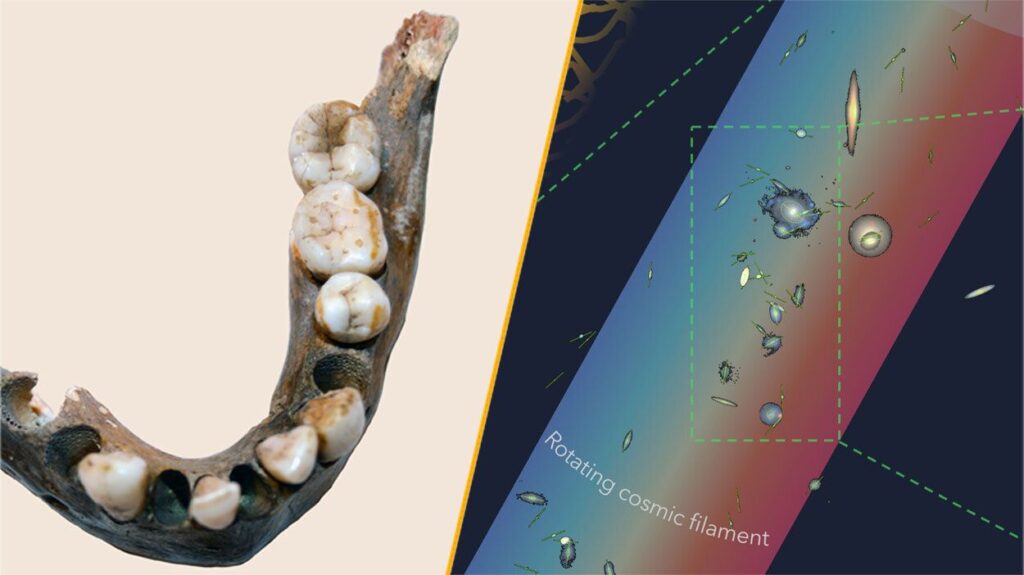
This week in science has unveiled groundbreaking discoveries that span the breadth of human history and the vastness of the universe. Researchers have identified the largest spinning structure known to exist, located approximately 140 million light-years away, while significant findings in southern Africa reveal a human population that remained genetically isolated for around 100,000 years.
In an extraordinary cosmic revelation, scientists have detected an immense rotating filament that exceeds the width of the Milky Way. This filament, linked to a chain of 14 galaxies, spins at an impressive rate of approximately 68 miles per second (110 kilometers per second). The discovery highlights the dynamic nature of the universe, further confirmed through observations made by the James Webb Telescope.
Closer to home, a team of researchers studying human remains in southern Africa has uncovered skeletons dating back up to 10,000 years. These remains, found near the Limpopo River, exhibit a drastically different genetic profile compared to contemporary humans. The study’s findings indicate that this population represents “an extreme end of human genetic variation,” underscoring the diverse evolutionary paths our species has taken.
Archaeological work in China has also made headlines, with the discovery of a mass grave near a 4,000-year-old city. This site contained a substantial number of skulls, predominantly male, which deviates from known sacrificial patterns observed in nearby settlements. Additionally, researchers in Greece are analyzing a 2,700-year-old tomb that holds a woman adorned with an upside-down crown, raising further questions about ancient burial customs.
Meanwhile, environmental science is grappling with the consequences of large-scale ecological projects. A major tree-planting initiative in China, part of the Great Green Wall aimed at combating desertification, has inadvertently altered rainfall and evaporation patterns across the country. This has resulted in lower water levels in densely populated areas, presenting new challenges for water management.
In a surprising development, research suggests that the record for the highest temperature ever recorded on Earth, set in Death Valley in 1913, may have been influenced by human error. While scientists continue to investigate this claim, another study warns of potential drought conditions in Europe due to the collapse of a vital Atlantic current.
On a more celestial note, interstellar comet 3I/ATLAS has captured the attention of astronomers as it exhibits signs of “ice volcanoes.” Observations from the Joan Oró Telescope in northeastern Spain reveal that the comet is heating up and brightening as it nears the sun, indicating that ice is sublimating from its surface—similar to other bodies within our solar system.
In technological advancements, engineers at MIT have introduced a novel method for extracting drinking water from air, which could significantly benefit arid regions. Utilizing ultrasound waves, this new technique allows for efficient water extraction in mere minutes, overcoming the limitations of previous evaporation-based systems. The researchers are exploring the possibility of pairing this device with solar cells to address energy needs.
As the week concludes, the scientific community remains abuzz with discoveries and ongoing research. From ancient human history to the mysteries of the cosmos, every finding contributes to our understanding of life on Earth and beyond.