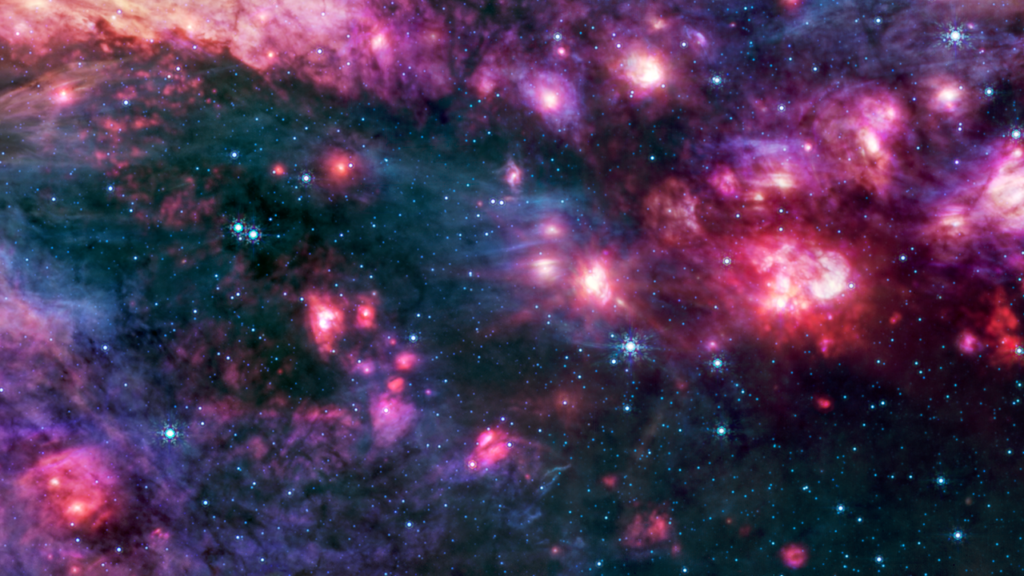
The **James Webb Space Telescope** (JWST) has captured stunning images of the **Sagittarius B2** molecular cloud, a significant star-forming region located approximately **26,000 light-years** from Earth in the constellation Sagittarius. This revelation, shared on **September 24, 2025**, showcases the detailed structure of a cloud that is pivotal in understanding star formation within the Milky Way.
The Sagittarius B2 cloud is remarkable not only for its size but also for its efficiency in star production. Spanning about **150 light-years** and boasting a mass between **3 million and 10 million times** that of the Sun, this cloud is responsible for creating half of the stars in the central region of the galaxy. Despite containing only **10%** of the gas found in the galactic center, its star-forming capabilities have intrigued astronomers.
Insights from JWST’s Imaging Capabilities
The images captured by JWST employ both the **Mid-Infrared Instrument** (MIRI) and the **Near-Infrared Camera** (NIRCam), providing complementary views of this celestial phenomenon. The MIRI image reveals clumps of gas and dust glowing in vibrant shades of pink, purple, and red, contrasting sharply with darker regions that conceal dense dust. These dark areas do not signify emptiness; rather, they indicate regions where light is obstructed, preventing detection by the instrument.
In contrast, the near-infrared images from NIRCam highlight the abundance of stars within the cloud, as stars emit strongly in this spectrum. The interplay between these different wavelengths allows researchers to gain a deeper understanding of the cloud’s composition and behavior.
The redder clumps observed in the MIRI image correspond to some of the most chemically complex areas known in the galaxy. Previous studies utilizing various telescopes have suggested that these regions may hold the key to understanding why Sagittarius B2 is so adept at star formation compared to other areas in the galactic center.
Future Research Directions
Further investigation into the masses and ages of the stars within this stellar factory could yield significant insights into the mechanisms driving star formation in the Milky Way. As astronomers analyze the data collected by JWST, they hope to unravel the mystery of how such a relatively small amount of gas can produce an astounding quantity of stars.
The discoveries made by JWST continue to expand our understanding of the universe, showcasing how advanced technology can unveil the hidden complexities of molecular clouds like Sagittarius B2. This latest imaging not only highlights the capabilities of JWST but also emphasizes the ongoing quest to comprehend the formation and evolution of stars in our galaxy.
For those interested in further cosmic revelations, the archives of the Space Photo of the Week offer additional breathtaking views and discoveries from the depths of space.